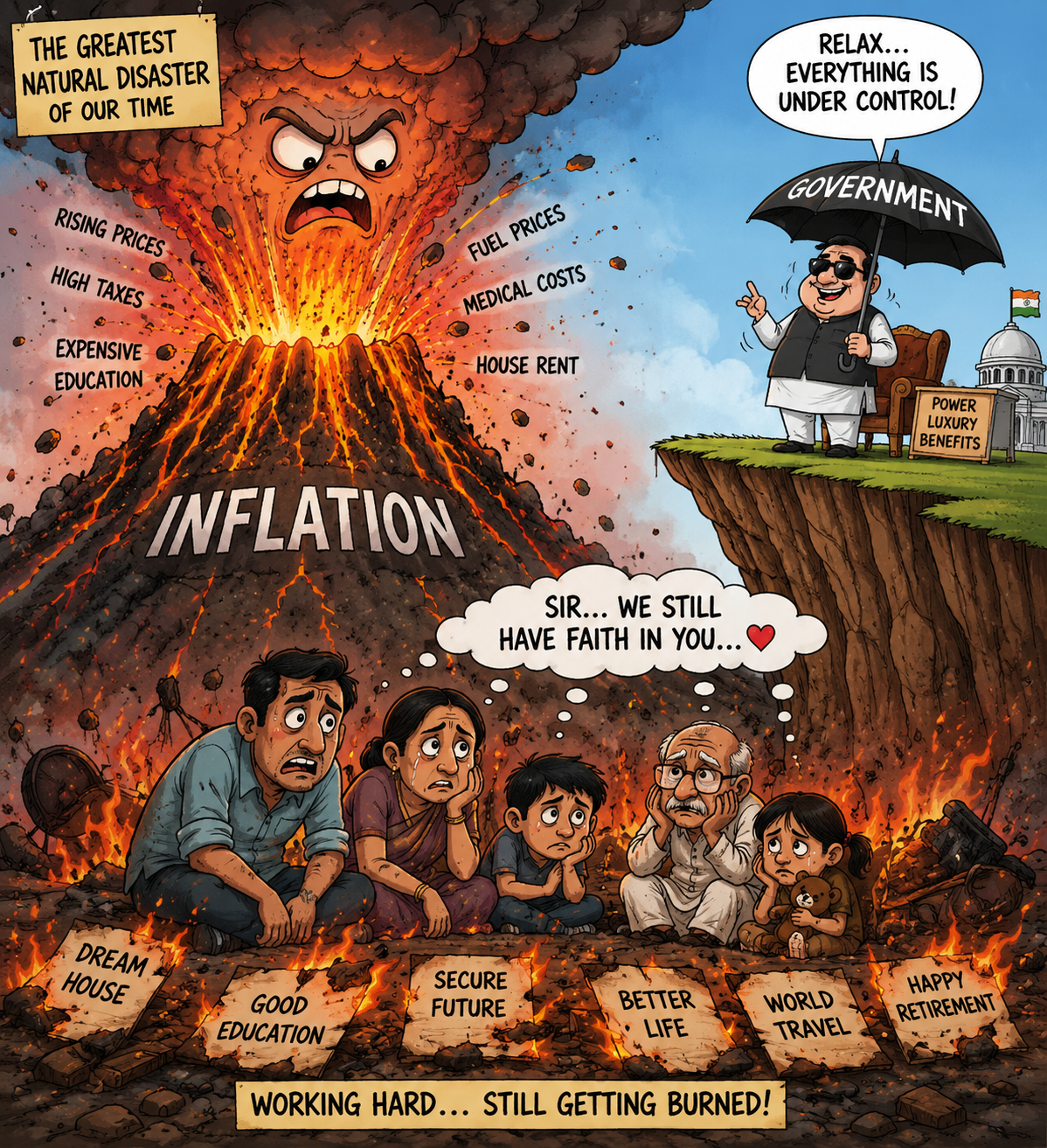
MIDDLE CLASS IN INDIA TAXED TRAPPED AND TIRED
THE GREAT INDIAN MIDDLE-CLASS TRAP
Every election season, the middle class suddenly becomes the backbone of the nation. Every budget season, the same backbone gets bent a little more. Leaders appear on stages promising development, employment, economic growth, and a brighter future for ordinary citizens. Emotional speeches are delivered, slogans are repeated endlessly, and people are asked to believe that better days are coming. But once the elections are over and power is secured, reality begins to look very different. The same middle class that was praised during campaigns slowly becomes invisible again. Promises fade, accountability disappears, and ordinary citizens are left to struggle with rising costs, weak financial security, and constant pressure.
Today, middle-class families in India are living in a cycle of survival rather than growth. Salaries may increase slightly, but inflation moves much faster. Petrol prices rise, school fees rise, rent rises, electricity bills rise, medical expenses rise, and daily necessities become more expensive every year. Yet the average citizen is still expected to manage everything quietly without complaint. A person earning a decent salary is now only one medical emergency away from financial instability. The pressure of maintaining a family, paying EMIs, supporting children’s education, and planning for the future has become mentally exhausting for millions of hardworking people.
POWER CHANGES PEOPLE — AND PROMISES DISAPPEAR
One of the biggest disappointments for citizens is how quickly political priorities seem to change once leaders reach positions of power. Before elections, politicians speak like servants of the people. They promise employment opportunities, affordable living, reduced corruption, stronger governance, and support for the middle class. Every speech sounds hopeful and every manifesto looks inspiring.
However, once the power seat is secured, many promises slowly disappear. Accountability becomes silence, criticism is often ignored, and ordinary people begin feeling disconnected from the very leaders they trusted. Citizens naturally begin asking difficult questions. Why do leaders remember the public only during elections? Why do promises fade after victory? Why does power often become more important than service? Democracy is not just about winning votes; it is about protecting the trust of people after entering office.
STOP COMPARING WITH WESTERN CRISES — FIX YOUR OWN HOUSE FIRST
Whenever citizens raise concerns about inflation, unemployment, falling savings, or poor governance, comparisons with Western countries immediately begin. People are told that other nations are also struggling with economic problems, inflation, or recession. But ordinary citizens are asking a simple and powerful question: why focus so much on foreign crises when our own country is still developing?
India has enormous talent, manpower, intelligence, and potential. Yet millions continue struggling for quality education, affordable healthcare, stable employment, and reliable infrastructure. Citizens cannot build their future on speeches, global comparisons, or political marketing. They need practical governance that improves daily life. A developing nation should focus first on strengthening its own foundation instead of constantly trying to prove that others are doing worse.
BANK INTEREST FALLING, SAVINGS LOSING VALUE
Another growing frustration for the middle class is the declining value of savings. Earlier generations believed that if they studied hard, worked honestly, and saved money carefully, they could slowly build a secure future. Fixed deposits and savings accounts once provided confidence and stability for families.
Today, that confidence is weakening. Bank interest rates have fallen while inflation continues to rise steadily. As a result, even money kept safely in the bank slowly loses its real value over time. Retired individuals who depend on interest income struggle to cover monthly expenses, while middle-class families feel punished simply for trying to save responsibly. Citizens are often advised to invest in risky markets for higher returns, but not everyone can afford financial risks when survival itself has become uncertain.
WHY IS THE RUPEE GETTING WEAKER?
The falling value of the Indian rupee has also become a serious concern for ordinary people. Every time the rupee weakens against the US dollar, the effects become visible in daily life. Fuel prices rise, imported products become expensive, electronics cost more, and foreign education becomes harder to afford. The purchasing power of citizens slowly weakens while expenses continue increasing.
People naturally begin asking an important question: if the economy is growing so strongly, why does the rupee continue losing strength? Citizens may not understand every economic theory or global market trend, but they clearly understand one painful reality — their money buys less than before. The burden of economic imbalance ultimately falls on middle-class households already struggling under financial pressure.
TAXPAYERS WITHOUT PRIVILEGES
The middle class remains one of the most responsible contributors to the economy, yet often feels the least protected. Salaried employees pay income tax honestly, pay GST on almost every product, pay fuel taxes, toll taxes, property taxes, and several hidden charges in daily life. Yet when they expect quality public services in return, disappointment follows.
Broken roads, delayed government procedures, corruption in offices, overcrowded hospitals, poor infrastructure, and endless bureaucracy continue troubling ordinary citizens despite years of promises about modernization and development. If a taxpayer delays payment, penalties arrive quickly. But when citizens ask for accountability regarding poor public systems, responses often become slow or completely absent.
GOVERNMENT OFFICES: SERVICE OR SUFFERING?
For many people, visiting a government office still feels like entering a cycle of frustration. One signature is missing, one document is incomplete, one officer is unavailable, or one file is still “under process.” Citizens spend hours standing in queues, travel long distances, take leave from work, and still return home without completing basic tasks.
Digital India sounds impressive in speeches and advertisements, but on the ground many public systems continue to feel slow, disconnected, and difficult to navigate. Good governance is not measured by slogans. It is measured by how respectfully and efficiently ordinary citizens are treated. A truly progressive nation is one where people can complete basic public procedures without fear, corruption, humiliation, or endless delay.
TRAITOR POLITICS — A BETRAYAL OF DEMOCRACY
Another dangerous trend damaging public trust in the country is the rise of “traitor politics,” where elected representatives switch parties after winning votes from the people under a completely different ideology and promise. Citizens vote believing in one manifesto, one leadership, and one direction for governance, but after elections many politicians suddenly change sides for power, position, or financial benefit. This has slowly turned democracy into a marketplace where loyalty can be traded for money and influence.
People commonly describe this practice as “horse trading” because politicians are treated like assets being bought and sold between parties. A representative who wins under one party banner suddenly joins another party after receiving offers, minister positions, protection, or financial gains. In the end, it is not just politics that changes — the trust of millions of voters gets betrayed. Citizens begin feeling that their votes no longer have value if elected leaders can easily switch sides after elections.
Such political betrayal weakens democracy and destroys public confidence in governance. If an ordinary employee breaks an agreement or commits fraud, strict action follows immediately. But when politicians betray the mandate of people for personal gain, the system often treats it as “strategy” instead of wrongdoing. This culture sends a dangerous message that power matters more than principles.
Many citizens now believe that political defections done for money, power, or selfish benefit should be treated as a serious democratic offense. Leaders who switch parties after elections should face strict accountability, resignation requirements, or disqualification so that public trust can be protected. Democracy survives only when voters believe their mandate will be respected. Without political integrity, elections slowly lose meaning and governance becomes nothing more than a competition for power.
CAN YOU SAVE THE DREAMS OF THE MIDDLE CLASS?
This is the biggest question standing before every government today. Can you protect the dreams of citizens who study hard, work honestly, pay taxes regularly, and still struggle to live peacefully? Can you build a nation where hard work genuinely leads to progress and stability?
If the answer is yes, then focus on strong governance, accountability, stable economic policies, transparent systems, and practical development. Build a country where youth can find opportunities, families can save confidently, and retirees can live with dignity. But if these dreams cannot be protected, then election speeches and promises slowly lose their meaning.
CONCLUSION
India possesses talent, ambition, intelligence, and hardworking people capable of achieving extraordinary success. However, without responsible governance, economic stability, accountability, and genuine concern for ordinary citizens, frustration will continue growing silently beneath the surface.
The middle class does not ask for luxury or special treatment. It asks for fairness, opportunity, stability, and dignity. It wants a government that remembers one simple truth: a nation becomes truly powerful not when leaders appear strong, but when ordinary citizens feel secure about their future.
#Goodgovernance #Inflation #Middleclassfamily #Backbone #Justremember