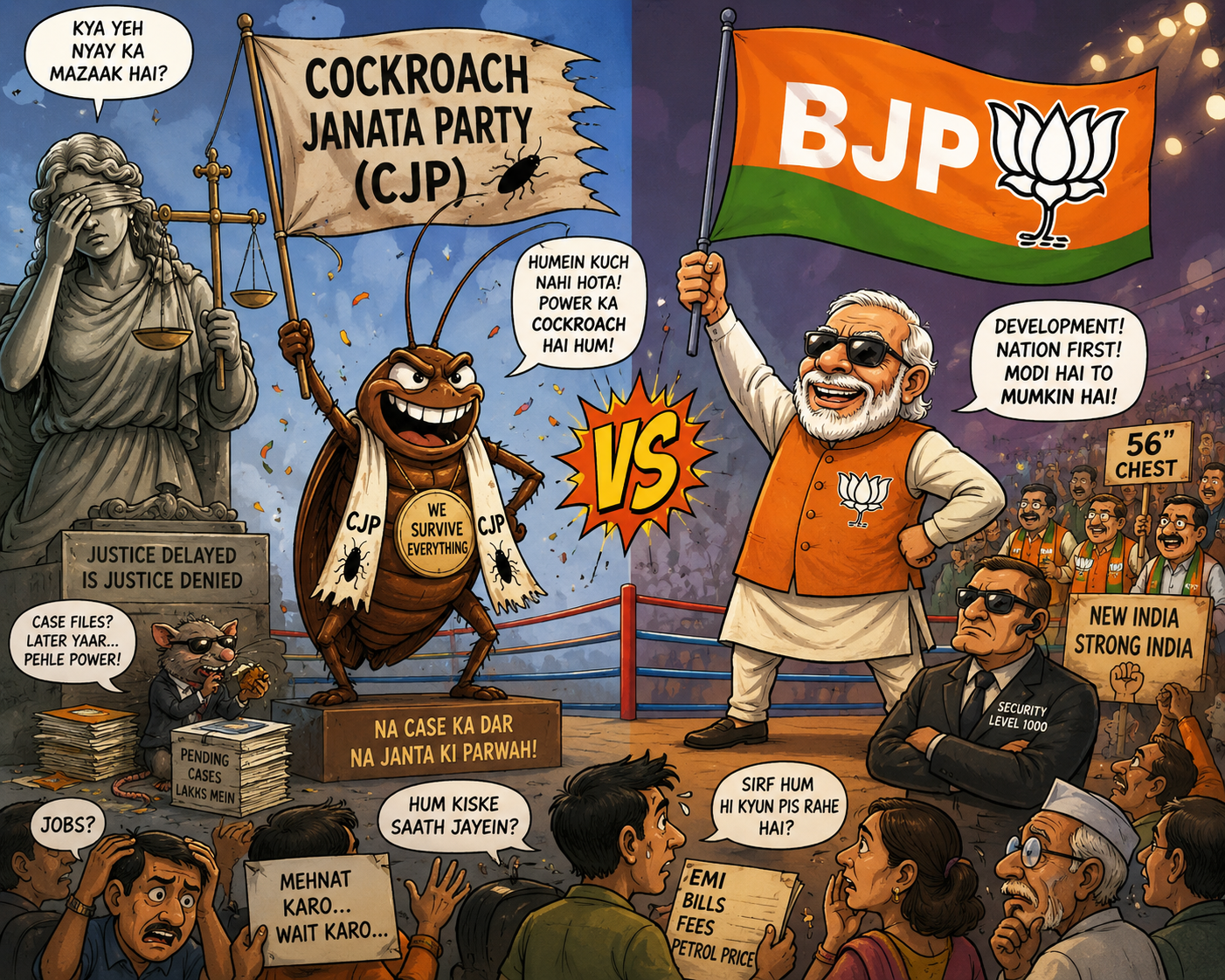
GOOD GOVERNANCE MISSING IN INDIA SEARCH OPERATIONS BEGIN VIA CJP
India was once called a land of opportunity, intelligence, culture, sacrifice, and resilience. A nation where people believed hard work could change destiny. A country where middle-class families survived with dignity, where youngsters dreamed fearlessly, and where citizens trusted that systems would eventually work for them.But today, the atmosphere feels very different.
The public is no longer asking whether India is developing.
The public is asking:
Who exactly is this development for?
Because for millions of ordinary citizens, life has become an endless cycle of pressure, taxes, stress, unemployment, inflation, emotional exhaustion, and political drama.
And now, after hearing youngsters indirectly compared with words like “parasites” and “cockroaches,” people sarcastically feel like a new political party has unofficially been launched:
“CJP” — Cockroach Janata Party.
A brutal nickname born not from comedy…
But from frustration.
Because today’s youth already feel crushed enough by reality.
A graduate applying to 500 jobs without response…
A youngster waking up at 4 AM for interviews…
A son hiding his stress from parents…
A daughter travelling daily with certificates in her bag searching for work…
Are these parasites?
Or are these the people silently carrying the nation’s economy on their backs?
An apology the next day does not magically erase the insult. Words spoken from powerful constitutional positions carry emotional weight. They shape public thinking. And when struggling youngsters hear such labels, the damage runs deep.
The youth of India are not cockroaches.
They are survivors trapped inside a collapsing pressure cooker system.
Meanwhile, every time citizens question unemployment, corruption, inflation, or failures in governance, suddenly the conversation changes direction.
Television debates start shouting about wars happening in the West.
Political spokespersons suddenly become international analysts.
Citizens asking local questions are given global distractions.
But the public wants simple answers.
Can Western wars reduce fuel prices in India?
Can those wars make groceries affordable?
Can they reduce unemployment?
Can they make 1 US Dollar equal to Rs 1?
No, right?
Then stop using global smoke screens to escape local accountability.
A government’s first responsibility is not international drama for TRP debates.
Its first responsibility is its own citizens.
Today, India’s middle class has become the nation’s biggest punching bag.
Too rich for subsidies.
Too poor for comfort.
They pay taxes honestly.
Pay EMIs honestly.
Work overtime honestly.
Follow rules honestly.
And in return?
More pressure.
More expenses.
More motivational speeches.
The rich find loopholes.
The corrupt find connections.
But the middle class finds only stress.
And then comes another “visionary push” — Electric Vehicles.
The government aggressively promotes EVs as if every Indian household has Silicon Valley salaries.
Reality check:
Millions of families are struggling to buy even normal petrol bikes.
Yet they are expected to suddenly transition into expensive electric vehicles while:
* charging stations remain limited,
* electricity costs rise,
* battery replacement costs scare buyers,
* and infrastructure gaps remain obvious.
Naturally, citizens are beginning to question:
Is this truly environmental concern…
Or another commission paradise dressed up as public welfare?
Because in modern India, public trust is declining rapidly.
People no longer react to corruption with shock.
They react with:
“Again ah?”
“Normal only.”
“Nothing will happen.”
That is the most dangerous stage for any democracy — when corruption becomes routine entertainment instead of national shame.
Political leaders with criminal cases continue enjoying security convoys, luxury lifestyles, and power. Cases drag for years. Investigations slow down mysteriously. Accountability disappears into paperwork.
And what does the public hear?
“Pending cases are not new to our system.”
Imagine hearing this in aviation:
“Plane crashes are not new.”
Or in hospitals:
“Deaths are not new.”
Would society accept that casually?
Then why should citizens accept delayed justice as normal governance?
Justice delayed is not just justice denied.
It is public trust murdered slowly.
And through all this chaos, one group continues carrying the burden silently — the youth.
The same youth mocked during speeches…
Used during elections…
Ignored after results…
And blamed whenever the system fails.
Today’s youngsters are not lazy.
They are mentally exhausted.
Not everyone has family wealth.
Not everyone has political background.
Not everyone has business inheritance.
Some people are literally one salary away from collapse.
They have:
* parents depending on them,
* loans waiting every month,
* rent deadlines,
* medical expenses,
* family expectations,
* and society constantly asking:
“Did you get any jobs yet?”
Yet despite all this pressure, they continue trying.
That is not parasitic behavior.
That is survival.
India does not lack talent.
India lacks honest governance.
If leaders truly know how to govern this nation properly, then govern with transparency, accountability, and humanity.
Fix unemployment.
Reduce corruption.
Strengthen education.
Speed up justice.
Respect citizens.
Stop insulting struggling youth.
Stop distracting the public with irrelevant noise whenever real questions are raised.
Because citizens are becoming emotionally tired of speeches without solutions.
And if governance today means:
* PR management,
* blame games,
* distractions,
* commissions,
* corruption,
* emotional manipulation,
* and treating citizens like disposable objects…
Then maybe it is time to step aside.
Because outside political dynasties and power circles, there are lakhs of talented youngsters capable of governing this nation with more honesty, compassion, and practical understanding.
India does not need rulers sitting above the public.
India needs leaders who stand among the public.
This article aims to examine the topic critically and fairly. The contents are not intended to target, insult, or diminish any person or organization.