31 Years Missing: Tibets Deepest Wound Still Bleeds
The Boy the Mountains Still Remember
31 Years of Silence, Prayer, and a Missing Soul of Tibet
On a quiet evening in Mussoorie, Dharmasala/Mcleodganj, Dehradun, beneath misty hills and flickering market lights, members of the Tibetan community walked silently with candles in their hands. Some carried photographs. Some whispered prayers. Others simply walked with lowered eyes, as if carrying a grief too old for words.
The protest was not merely political. It was spiritual. Emotional. Almost ancestral.
They had gathered for a boy the world has not seen for 31 years.
The 11th Panchen Lama.
For many Indians unfamiliar with Tibetan Buddhism, the name may sound distant. Yet for Tibetans across the Himalayas from Dharamshala to Mussoorie the Panchen Lama is not just a monk. He represents continuity, sacred memory, and the living thread of their civilization.
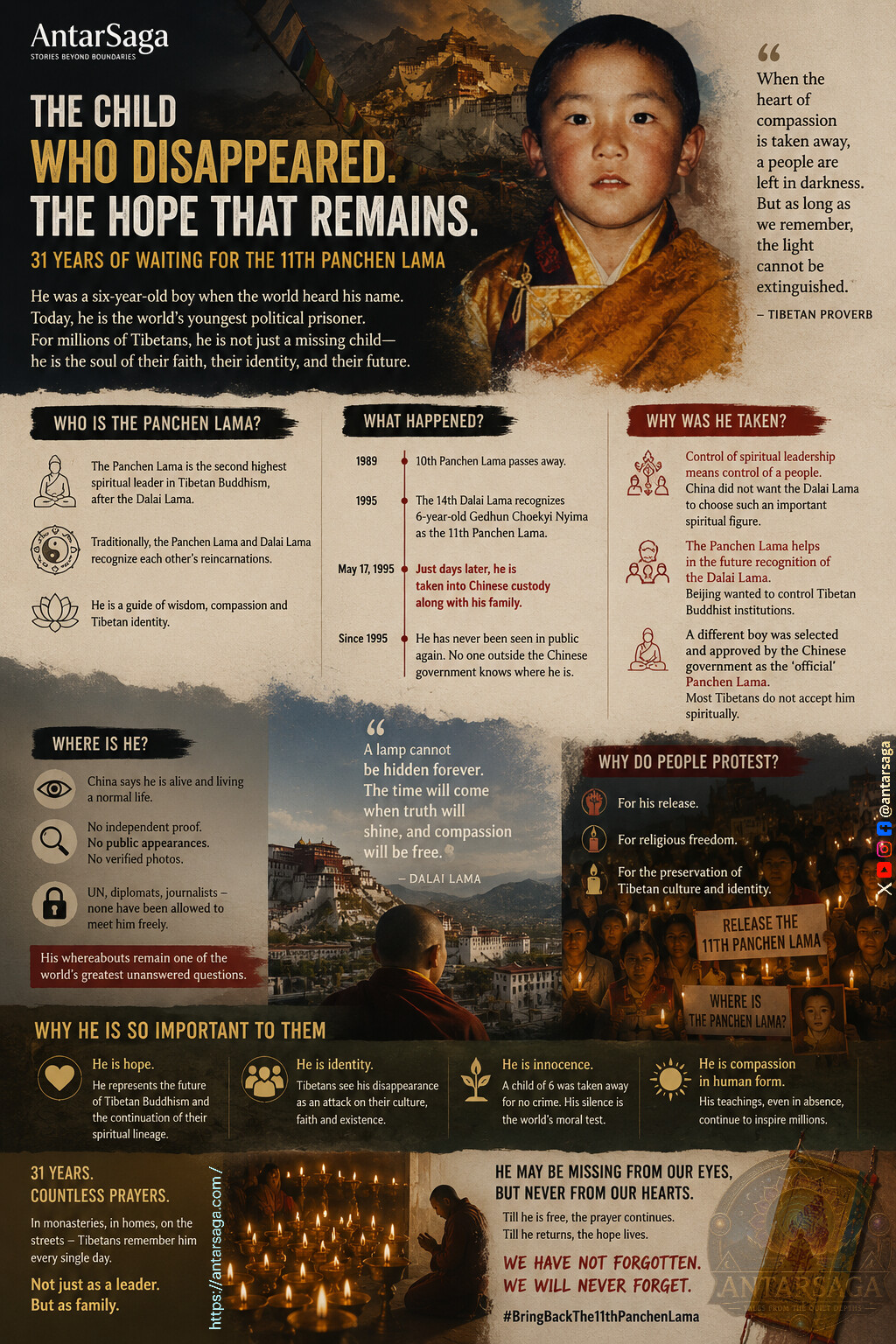
In Tibetan Buddhism, the Panchen Lama is considered second only to the Dalai Lama in spiritual importance. Traditionally, the Dalai Lama and Panchen Lama help identify each others reincarnations, ensuring the continuation of a sacred lineage believed to transcend death itself.
But in 1995, something happened that still haunts Tibetans around the world.
After years of religious rituals and spiritual consultations, the Dalai Lama recognized a six-year-old Tibetan boy named Gedhun Choekyi Nyima as the true reincarnation of the 11th Panchen Lama. Days later, the child disappeared.
Along with his family.
He was never publicly seen again.
Human rights organizations, Tibetan exile groups, and many international observers allege that Chinese authorities took the boy into custody shortly after his recognition. China later appointed another Panchen Lama approved by the state. But for many Tibetans, the officially selected figure never carried the spiritual legitimacy of the missing child.
And thus began one of the worlds strangest and saddest silences.
Today, Gedhun Choekyi Nyima would be around 37 years old. Yet no verified photograph of him as an adult exists. No interview. No public appearance. No independent confirmation of his condition.
China maintains that he is alive and living privately. But secrecy has only deepened the mystery.
To Tibetans, this is not simply about one missing person.
It is about the disappearance of trust itself.
The Panchen Lama occupies a sacred position because Tibetan Buddhism does not separate politics from spirituality in the way modern states often do. In Himalayan cultures, spiritual figures are not merely religious leaders they are custodians of wisdom, ethics, compassion, and identity. Removing such a figure creates not just political uncertainty, but existential loss.
This is why elderly Tibetan women still cry during candle marches. Why monks continue prayers decades later. Why small refugee settlements in India still speak his name softly, as though afraid silence itself might erase him completely.
In Mussoorie, the recent protest by Tibetan womens groups reflected this pain. Participants carried candles through the hill town demanding religious freedom and the release of the Panchen Lama. To outsiders, it may have appeared like a small local demonstration. But emotionally, it carried the weight of an unresolved wound stretching across generations.
Perhaps the deeper tragedy is philosophical.
Modern civilization increasingly measures power through armies, economies, surveillance, and territory. But Tibets worldview has always revolved around something softer inner peace, reincarnation, prayer, silence, and compassion. The disappearance of the Panchen Lama symbolizes a collision between two very different visions of reality: one rooted in control, the other in consciousness.
And yet, despite exile, loss, and decades of uncertainty, Tibetan culture has not vanished.
Prayer flags still flutter across Himalayan winds. Monasteries still echo with chants. Children still learn stories of compassion and impermanence. Elderly refugees still bow before photographs of leaders they may never see again.
There is something deeply human in this persistence.
Because memory itself can become resistance.
The story of the Panchen Lama also raises uncomfortable questions for the modern world. Can spiritual identity survive political domination? Can ancient traditions survive the machinery of the modern state? And what happens when a civilization loses not just land, but symbols?
Perhaps that is why the image of the missing boy still affects so many people globally. Not because everyone understands Tibetan Buddhism, but because everyone understands absence.
A child disappears. A people continue waiting.
And somewhere between faith and uncertainty, hope survives.
The philosopher in the mountains may say that truth cannot remain buried forever. History has shown that empires rise and collapse, but cultural memory often outlives both violence and power. The Tibetan community understands this deeply. Their struggle is not only for territory or politics, but for the right to remember who they are.
That is why, even after 31 years, candles still burn in places like Mussoorie.
Not merely in protest.
But in remembrance.