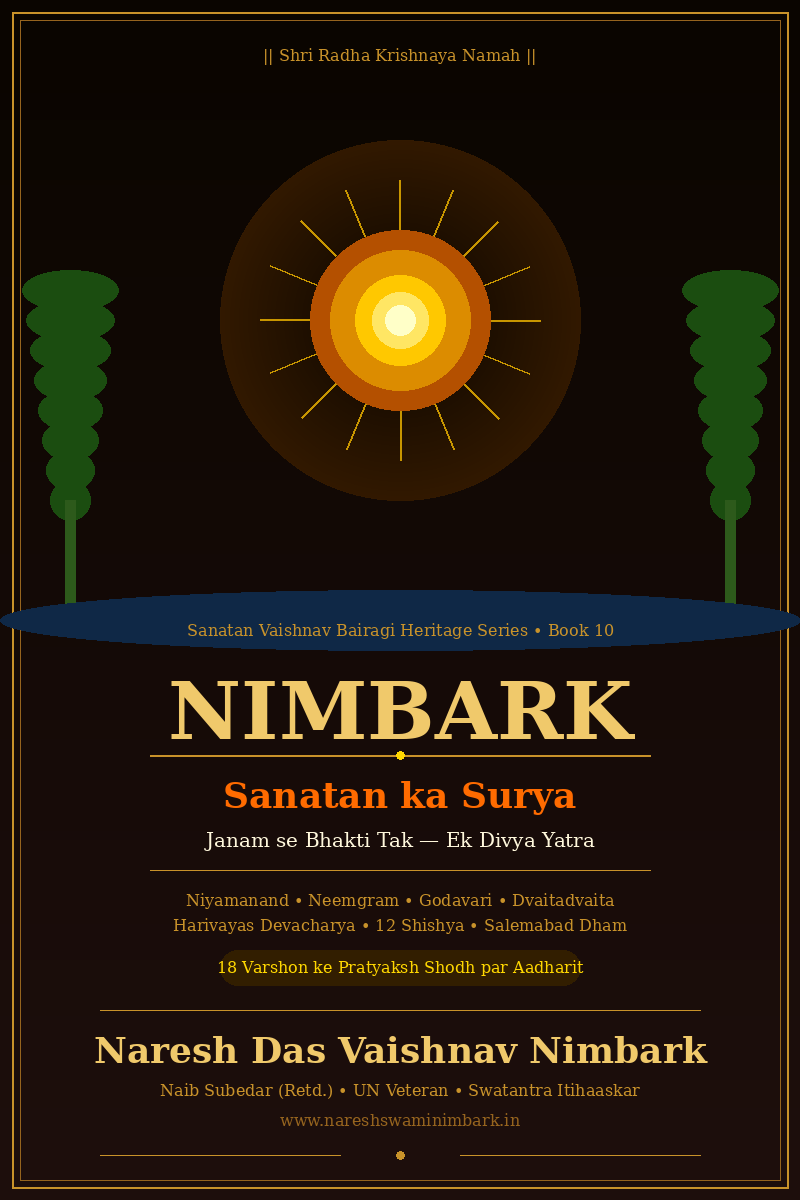
Born in 3096 BC on the Banks of Godavari: The Jagadguru India Forgot
Born in 3096 BC on the Banks of Godavari: The Jagadguru India Forgot
By Naib Subedar (Retd.) Naresh Das Vaishnav Nimbark
Independent Historian | Sanatan Vaishnav Bairagi Tradition Researcher
www.nareshswaminimbark.in
There is a village in Maharashtra that most Indians have never visited and a name that most Indians have never heard.
The village is Mungi situated on the sacred banks of the Godavari river, approximately 15 kilometres from Paithan tehsil, in Chhatrapati Sambhajinagar district.
The name is Jagadguru Bhagwan Sri Nimbarkacharya.
He was born here on the auspicious occasion of Kartik Purnima, 3096 BC making this year his 5,122nd birth anniversary.
And yet this birthplace has no national recognition. No heritage status. No pilgrimage declaration from the government.
This is not just a historical oversight. It is a civilisational failure.
Who Was Jagadguru Nimbarkacharya?
Among the four great Vaishnav traditions of Sanatan Dharma the Nimbark Sampraday stands first. It is the oldest. And its founder is Jagadguru Bhagwan Sri Nimbarkacharya.
He was born as Niyamananda to Arun Rishi and Jayanti Devi at Mungi village a place ancient texts refer to as Vaidurya Pattana or Mungi Paithan.
He is revered as the avatar of the Sudarshana Chakra the divine discus of Lord Vishnu who descended to earth to restore and establish the path of devotion.
His contribution to Sanatan Dharma rests on three pillars:
First He established the Dvaitadvaita (Bhedabheda) philosophy, a profound middle path that declares the soul is simultaneously distinct from God and inseparable from Him. The world is not an illusion it is a real expression of divine power.
Second He was the first Acharya in Sanatan Dharma to formally declare Sri Radha as the Swarupa-Shakti the essential, eternal power of Sri Krishna. He established the worship of Radha-Krishna as the divine Yugal Swaroop at the very heart of spiritual practice.
Third He gave this civilisation the understanding that love (Prema) is the highest spiritual path above ritual, above intellectual knowledge, above all else.
These are not minor contributions. These are the foundations upon which the devotional life of hundreds of millions of Indians has rested for over five thousand years.
The Story Behind the Name
The name Nimbarkacharya carries within it a miraculous story one that has been passed down through generations of devotees and recorded in the sacred texts of the tradition.
One evening, a wandering ascetic arrived at the young sage Niyamananda's ashram seeking food. The sun had set. By the rules of the time, food could not be offered after sunset.
But Niyamananda, moved by pure compassion for his guest, performed a miracle. He held the sun in place resting it upon a Nimba (neem) tree so that the evening meal could be prepared and served with full propriety and devotion.
Nimba (neem tree) + Arka (sun) = Nimbarka.
From Niyamananda to Neemananda and from Neemananda to Nimbarkacharya. This is the journey of a name that carries within it the power of compassion, righteousness, and divine grace.
The First Voice for Radha
Long before Mirabai sang. Long before Surdas composed his immortal verses. Long before the Bhakti movement swept across the Indian subcontinent
Jagadguru Nimbarkacharya had already declared the eternal truth:
Radha and Krishna are inseparable. The worship of Krishna without Radha is incomplete. The worship of Radha without Krishna is incomplete. Only together as the eternal Yugal are they the fullness of the Divine.
This declaration, made over 5,000 years ago, was revolutionary. At a time when the worship of Radha had not yet become widespread in other traditions, this Jagadguru placed her at the very centre of devotional life.
This is why the Nimbark Sampraday is also known as the Radha Sampraday.
And this is why every home, every temple, every kirtan that celebrates Radha-Krishna together today carries knowingly or unknowingly the legacy of Jagadguru Nimbarkacharya.
A Soldier's Field Report: What I Found at Mungi Village
I served in the Indian Army for 24 years. I was deployed on a United Nations Peacekeeping Mission in Sierra Leone. After retirement, I took up the pen with the same sense of duty and discipline that the uniform had taught me.
In January 2025, I travelled to Mungi village for field research.
The road from Chhatrapati Sambhajinagar is straightforward. The village is large and inhabited. On the banks of the Godavari that most sacred of rivers stands a magnificent temple.
I met with local pandits and scholars. Their devotion was deep and their knowledge was rich. The atmosphere of the place carried that unmistakable quality of sanctity the kind that a soldier learns to recognise after years of standing in places where something greater than human effort seems to be present.
But as I looked around I saw no heritage board. No government signage. No national declaration marking this as the birthplace of one of India's greatest spiritual luminaries.
Compare this to the birthplaces of other saints and philosophers across this land sites that receive lakhs of pilgrims, government funding, media attention, and national celebration every year.
The contrast is not merely disappointing. It is unjust.
The Warriors History Forgot
There is another chapter of the Nimbark Sampraday that has been almost entirely erased from public memory and as a military veteran, this chapter speaks to me most directly.
The Vaishnav Bairagi saints of this tradition were not only men of prayer.
When the temples of this land were demolished during the period of Mughal invasions when sacred pilgrimage sites were being desecrated and the faithful were being persecuted these saints did not retreat into silence.
They organised. They armed themselves. They fought.
They held the rosary in one hand and the sword in the other.
This history of Vaishnav Bairagi warrior-saints who laid down their lives to defend Dharma and the motherland is not found in any school textbook. It is not part of the national curriculum. It has been systematically ignored by mainstream historical writing.
But it happened. It is documented in manuscripts and oral traditions preserved by communities across this country.
Recovering this history writing it with the rigour of a soldier and the devotion of a sevak is the central mission of my life as an independent historian.
The Demand: Mungi Nimbark Teertha
I have formally proposed that Mungi village be officially declared "Mungi Nimbark Teertha" a national pilgrimage site of the highest importance.
The birthplace of the founder of India's oldest Vaishnav tradition, born 5,122 years ago, on the banks of the sacred Godavari deserves nothing less.
Other great Acharyas of this land have their birthplaces celebrated, protected, and promoted as centres of national heritage. The same honour must be extended to Jagadguru Bhagwan Sri Nimbarkacharya.
This is not a sectarian demand. It is a civilisational duty.
What Comes Next
Every year, by the grace of the Lord and the love of devotees, I organise the Nimbark Jayanti celebration honouring the birth of this great Jagadguru on Kartik Purnima.
My ninth book currently under research will be dedicated entirely to the life of Jagadguru Nimbarkacharya, the philosophy of the Nimbark Sampraday, and the untold history of the Vaishnav Bairagi warrior tradition.
This book is not merely a scholarly exercise. It is a debt owed to the tradition, to the motherland, and to the countless unnamed saints and soldiers who kept this sacred flame alive across more than five thousand years.
For more information, research articles, and updates on the Nimbark Jayanti and the Mungi Nimbark Teertha campaign:
www.nareshswaminimbark.in
Jai Sri Radhe
Naib Subedar (Retd.) Naresh Das Vaishnav Nimbark
Independent Historian | Sanatan Vaishnav Bairagi Tradition Researcher
Keywords: Jagadguru Nimbarkacharya, 3096 BC, Nimbark Sampraday, Mungi Village Godavari, Kartik Purnima, Radha Krishna, Dvaitadvaita, Vaishnav Bairagi Warriors, Mungi Nimbark Teertha, Indian Heritage, Sanatan Dharma