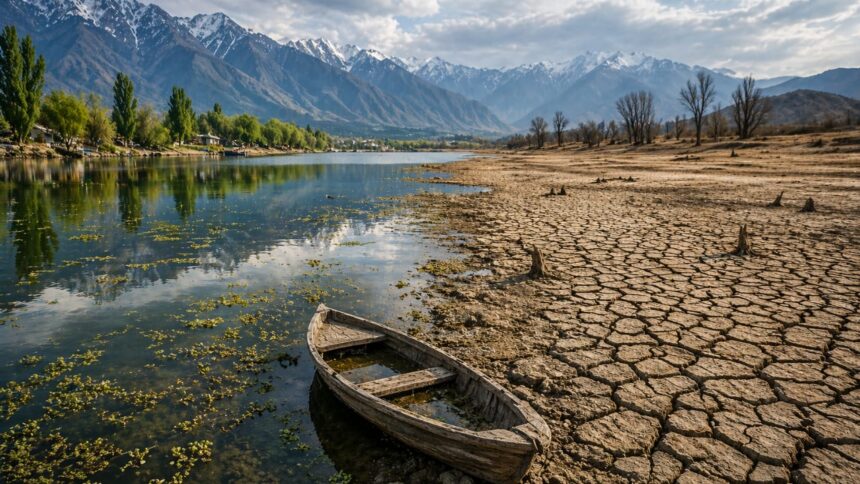
Analysis | A silent disaster: 45% of J-K lakes have disappeared


Srinagar, Apr 23: When everybody is responsible, nobody is responsible. That warning now stands true for the lakes and wetlands of Jammu and Kashmir, where fragmented governance and a non-cohesive approach have pushed a silent environmental catastrophe to the brink. It is high time to establish a central regulatory body as an umbrella organisation to ensure coordinated protection, restoration, and monitoring of these water resources.
Jammu and Kashmir has long been known for its abundant water resources, including its famous lakes and ecologically significant wetlands. However, a report by the Comptroller and Auditor General (CAG) has presented an alarming picture of the region’s deteriorating water bodies.
Out of 697 lakes recorded in 1967, around 315 have completely disappeared, while 203 have shrunk in size, involving nearly 1,500 hectares of land loss. In addition, 518 lakes have reduced water spread, and 63 have shrunk to less than half of their original size. Nearly 45 percent of the region’s lakes are now untraceable.
This depletion is not merely about disappearing lakes. It directly threatens biodiversity, migratory birds, aquatic life, groundwater recharge systems, and local livelihoods dependent on fishing and tourism. The decline of wetlands also weakens ecological resilience and environmental balance, creating long-term risks for human habitation.
One of the key reasons behind this crisis is fragmented management. Responsibility for lakes and water bodies is divided among multiple departments, including Revenue, Agriculture, Irrigation, Fisheries, and Forest, alongside agencies such as Lakes and Waterways Development Authority and Lakes Conservation Authority.
However, decades of poor coordination, overlapping jurisdictions, policy paralysis, and lack of accountability have severely undermined conservation efforts.
Unchecked pollution, encroachments, and inadequate restorative measures such as deweeding, desilting, and sewage management have further worsened the crisis.
Conservation efforts have largely remained limited to prominent water bodies such as Dal Lake, Wular Lake, Manasbal Lake, Hokersar Wetland, Surinsar Lake, and Mansar Lake, while smaller lakes and ponds—vital units of the broader ecological network—have been neglected.
Combined with climate stressors such as global warming, glacier melt, flash floods, landslides, shrinking green cover, and erratic rainfall patterns, the disappearance of lakes could trigger biodiversity collapse, rising flood risks, and future water scarcity due to poor groundwater recharge.
The time for symbolic concern has passed. What is urgently needed is an integrated, accountable, and science-based institutional mechanism with clear authority over all lakes and wetlands of the region. A central regulatory body must ensure mapping, legal protection, restoration, pollution control, encroachment removal, and long-term monitoring.
If decisive action is delayed further, the loss will not only be ecological but also social, economic, and existential. Protecting these water bodies is no longer optional; it is essential for sustaining life itself.
Disclaimer: This analytical commentary has been contributed to Asian News Hub by Hilal Bhat, who holds Master’s and MPhil degrees in Biotechnology and is working in the Department of School Education. The views expressed are personal and do not necessarily reflect those of Asian News Hub.