From Rivalry to Realignment: India, China and the Architecture of a New World Order
In a shifting world of currencies, conflicts, and power, the real question is whether India and China can build what comes next—together.
There are moments in history when the world does not collapse—it quietly rearranges itself. We are living in such a moment. The wars in Ukraine, the rising tensions involving Iran, the United States, and Israel, and the slow but visible cracks in the dollar-dominated financial system are not isolated events. They are signals. Signals that the old order is tiring, and a new one is beginning to take shape.
And in this shifting landscape stand two ancient civilisations—India and China—facing each other not just across the Himalayas, but across history itself.
For decades, we have been taught to see this relationship through the lens of conflict: borders, incursions, rivalry. But what if that lens itself is outdated? What if the real question is not whether India and China will compete—but whether they can afford not to collaborate?
Because the world outside is already changing.
The Iran conflict has shaken the foundations of global energy trade. Nearly 20% of the world’s oil flows through the Strait of Hormuz, and disruptions there have sent shockwaves across markets. But amid this uncertainty, something more subtle is happening—the gradual shift away from the dollar as the centre of global trade. Iran has increasingly shown willingness to accept Chinese yuan in certain energy transactions, quietly stepping away from a system that has dominated for decades.
Russia has gone even further. Under Western sanctions, a significant portion of its trade with China is now conducted in rubles and yuan. The Chinese currency is steadily gaining ground in energy settlements, and even Indian refiners, while purchasing Russian crude, have at times explored non-dollar payment mechanisms, including yuan. These are not isolated events—they are early signs of a parallel financial system beginning to emerge.
At the same time, recent developments reveal a more complex reality. Even as alternatives to the dollar gain traction, key economies in West Asia continue to rely on dollar-based systems for stability. The United Arab Emirates, for instance, has explored financial safety mechanisms linked to the US during the Iran conflict. This shows that the transition is not a sudden replacement of one system by another, but a gradual layering of alternatives alongside an existing order.
This is not yet a revolution. But it is clearly a direction.
The question is: where does India stand in this emerging order?
India is still catching up in manufacturing and supply chains—areas where China has built a strong lead over decades. But India brings something equally important: a young population, a flexible system, and a civilisational philosophy that has long understood unity beyond differences.
And this is where the conversation must move beyond economics.
In Advaita Vedanta, the central idea is simple yet profound: separation is an illusion. The boundary we draw between “self” and “other” is not absolute. Both are part of a larger reality. Applied to geopolitics, this becomes a powerful thought—perhaps nations too are not permanent rivals, but different expressions of the same human goals: security, growth, and continuity.
India and China, in that sense, are not opposites. They are reflections.
Both seek stability in a changing world. Both seek influence as power shifts eastward. Both seek dignity after long historical struggles. Yet both remain tied to a narrative of mistrust that belongs more to the past than the future.
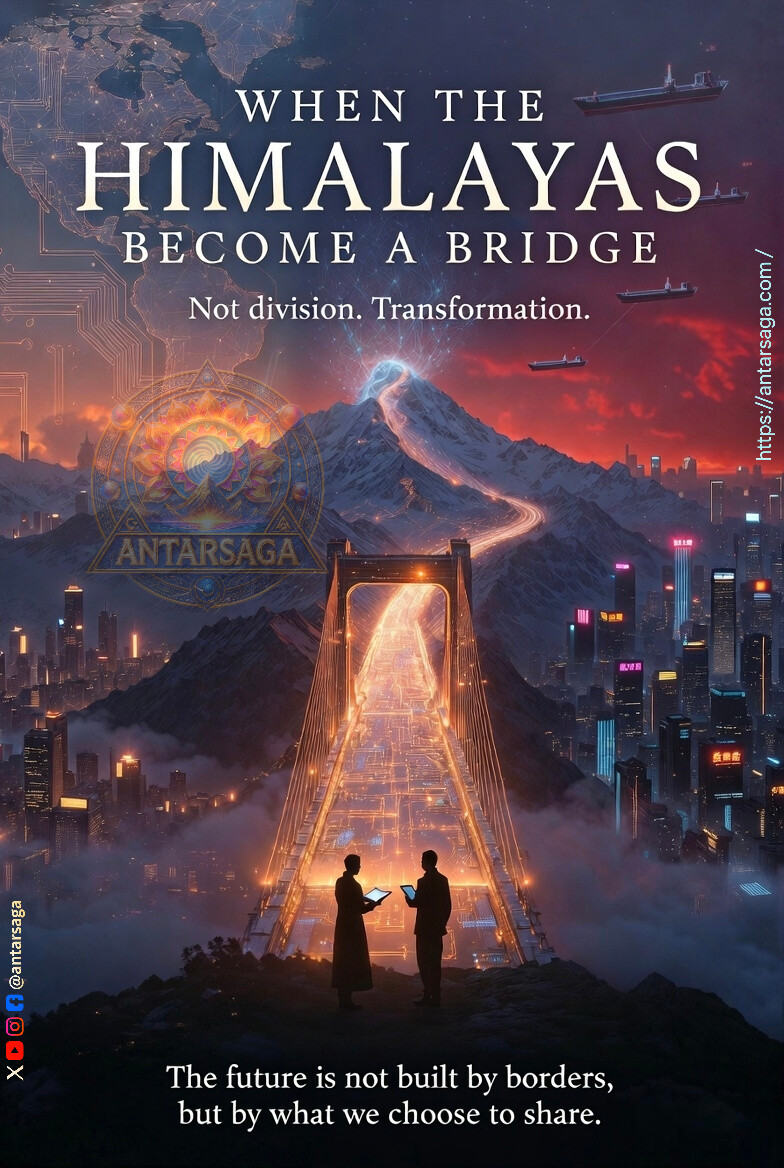
The Himalayas, long seen as a boundary, could become something else.
Instead of a line of conflict, imagine a shared corridor of cooperation. Economic zones near disputed areas. Tourism circuits connecting Kailash Mansarovar, Ladakh, and Tibet. Infrastructure built not for military assertion, but for economic growth. Roads that carry traders instead of troops.
It may sound idealistic. But history often moves forward when problems are redefined, not just managed.
The border dispute today is not just costly—it is increasingly outdated. Maintaining troops in extreme conditions year after year drains vast resources from both sides. Those same resources could instead build schools, digital infrastructure, and climate resilience. Because the real competition of this century will not be over land—it will be over intelligence.
Artificial Intelligence is not just another technology. It is a turning point. It will reshape jobs, education, and economies. In that world, old-style territorial rivalries will begin to look less important. What will matter is who adapts faster.
And here lies the strongest case for India–China cooperation—not friendship, not alliance, but alignment.
India’s strength in software and services combined with China’s strength in manufacturing. Joint work in climate, healthcare, and automation. Regional supply chains that reduce global dependence. This is not emotion—it is strategy.
The yuan’s growing role in global trade points toward a larger shift. The future may not belong to a single dominant currency, but to multiple regional systems. Digital currencies, local trade arrangements, and bilateral settlements are already reducing dependence on the dollar. The old system is not collapsing—but it is slowly loosening.
What makes this moment even more significant is that economics may succeed where politics has struggled.
For decades, India and China have treated their border as a line to defend. But the future may lie in treating it as a space to share. Joint economic zones in sensitive regions—carefully designed, mutually beneficial, and strategically balanced—could transform the nature of the dispute itself. A border that generates value becomes easier to stabilise than one that only consumes resources.
China has long indicated its interest in reducing dependence on dollar-based systems and expanding the use of the yuan. But for India, the opportunity lies not in simply following that shift, but in shaping something broader.
Over time, this could evolve into a coordinated Asian financial framework—where major economies like India, China, and even Russia settle trade through shared systems. Not a single currency immediately, but a gradual move toward a common trading mechanism for Asia. And if trust deepens over decades, even the idea of a shared trading currency may no longer seem distant.
For India, such a development could bring significant advantages. It could reduce currency risks in trade, strengthen energy security, and increase bargaining power in global markets. More importantly, it would allow India to participate as an equal architect of a new financial order, rather than adapting to one shaped elsewhere.
But currency follows confidence. And confidence follows cooperation.
If India and China can begin by turning their borders into zones of opportunity instead of tension, then deeper economic and financial integration may naturally follow.
Because in the end, geopolitics is not just about power—it is about perception.
If India sees China only as a threat, and China sees India only as a rival, then even cooperation will remain fragile. But if both begin to see each other as necessary partners in a changing world, then even competition can become constructive.
Advaita does not deny difference. It simply reminds us that difference is not everything.
India and China will always be different. But difference does not have to mean division. It can mean balance. It can mean strength.
The dragon and the dharma do not have to clash.
The future will not be decided by who wins the next border standoff. It will be decided by who understands this moment better—and has the courage to act on it.
Perhaps the Himalayas were never meant to divide.
Perhaps they were always meant to pause us.
A pause between conflict and clarity.
Between history and possibility.
The time has come to move beyond that pause.