Stocks slide in Asia, Brent crude heads for record monthly rise
Source by: CNA Digital NEWS Hub
30 Mar 2026, 07:12 AM
Stocks slide in Asia, Brent crude heads for record monthly rise
Brent crude has gained 59 per cent this month, topping the jump that followed Iraq's invasion of Kuwait in 1990.
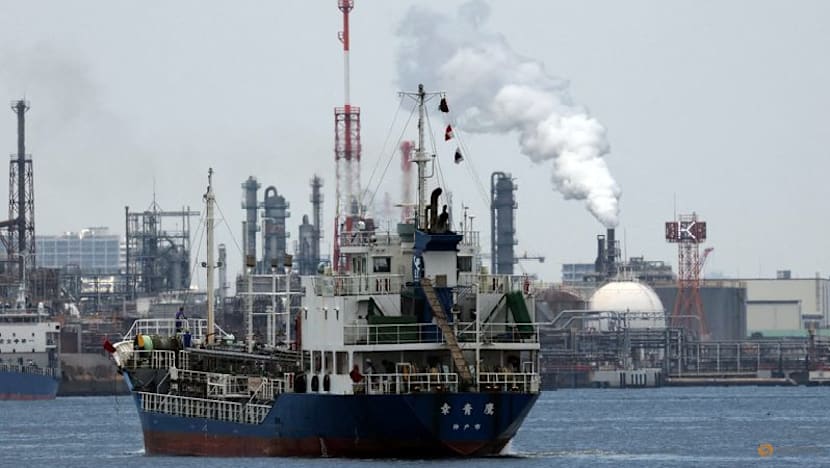
A small tanker sails near an oil refinery, in the Keihin Industrial Zone in Kawasaki, south of Tokyo, Japan, on Mar 17, 2026. (File photo: Reuters/Issei Kato)
SYDNEY: Asian stocks slid on Monday (Mar 30), with Brent crude headed for a record monthly rise, after Yemeni Houthis launched their first attacks on Israel over the weekend, widening the US-Israel war with Iran in the Middle East.
Minutes after Asian markets opened, a barrel of North Sea Brent meanwhile rose 2.98 per cent to US$115.93.
Japan's Nikkei tumbled over 5 per cent in early trade on Monday. South Korea's Kospi dipped more than 4 per cent.
Brent has soared 59 per cent this month, the steepest monthly jump, exceeding gains seen during the 1990 Gulf War, after the Iran conflict effectively closed the Strait of Hormuz, a conduit for a fifth of the world's oil and gas supplies.
"Iran's control of the Strait of Hormuz, capacity to disrupt global energy and food markets, and sustained missile and drone capabilities give it little incentive to concede, pressuring the US to escalate," said Madison Cartwright, senior geo-economics analyst at CBA.
"We expect the war to run at least into June, with the risk tilted to a longer conflict."
Yemen's Iran-aligned Houthis also launched their first attacks on Israel since the start of the conflict.
"The conflict is no longer concentrated in the Persian Gulf and around the Strait of Hormuz, but now extends into the Red Sea and the Bab el-Mandeb - one of the world's most crucial chokepoints for crude and refined product flows," JP Morgan analysts led by Natasha Kaneva said in a note.
Saudi crude exports redirected from the Strait of Hormuz to the Yanbu port in the Red Sea reached 4.658 million barrels per day last week, data from analytics firm Kpler showed.
If exports from Yanbu were disrupted, Saudi oil would need to pivot toward Egypt’s Suez-Mediterranean (SUMED) pipeline to the Mediterranean, JP Morgan analysts said.
Much of Asia is highly dependent on energy from the Middle East.
The clampdown on the Strait has also sent prices for fertiliser, plastic and aluminium surging, along with fuel for planes and shipping. Prices for food, pharmaceuticals and petrochemical products are all set to rise.
FED IN FOCUS AS PAYROLLS LOOM
The inflationary threat has led investors to revise up the outlook for interest rates almost everywhere. Markets now imply 12 basis points of tightening by the Federal Reserve this year, compared with 50 basis points of cuts a month ago.
Fed Chair Jerome Powell will have a chance to air his own views at an event later on Monday, and the influential head of the New York Fed, John Williams, is also talking.
Data on US retail sales, manufacturing and payrolls this week will provide an update on how the economy is travelling. Jobs are seen rising 55,000 in March, after February's shock 92,000 drop, keeping unemployment at 4.4 per cent.
In the European Union, figures on Tuesday are forecast to show annual inflation leapt to 2.7 per cent in March, from 1.9 per cent the month before, though core prices should be steadier.
The coming energy shock, combined with pressure on fiscal budgets from higher borrowing costs and the need for more defence spending, has slugged sovereign bond markets.
Ten-year US Treasury yields are up roughly 47 basis points for the month so far at 4.428 per cent, while two-year yields have climbed 54 basis points.
Heightened volatility in markets has tended to benefit the US dollar as the world's most liquid currency. The United States is also a net energy exporter, giving it a relative advantage over Europe and much of Asia.
The dollar was trading a touch firmer early on Monday at 160.42 yen, having last week crossed the 160 barrier for the first time since July 2024 when Japan last intervened to prop up the currency.
The euro was stuck at US$1.1492, not far from the March trough of US$1.1409.
In commodity markets, gold was little changed at US$4,487 an ounce, having drawn scant support as a safe haven or as a hedge against inflation risks.
*Devashish Govind Tokekar*
*VANDE Bharat live tv news Nagpur*
Editor/Reporter/Journalist
RNI:- MPBIL/25/A1465
*Indian Council of press,Nagpur*
Journalist Cell
*All India Media Association
Nagpur*
*District President*
*Delhi Crime Press*
RNI NO : DELHIN/2005/15378
AD.Associate /Reporter
*INDIAN PRESS UNION*
District Reporter
Contact no.
9422428110/9146095536
Head office:- plot no 18/19, flat no. 201,Harmony emporise, Payal -pallavi society new Manish Nagar somalwada nagpur - 440015