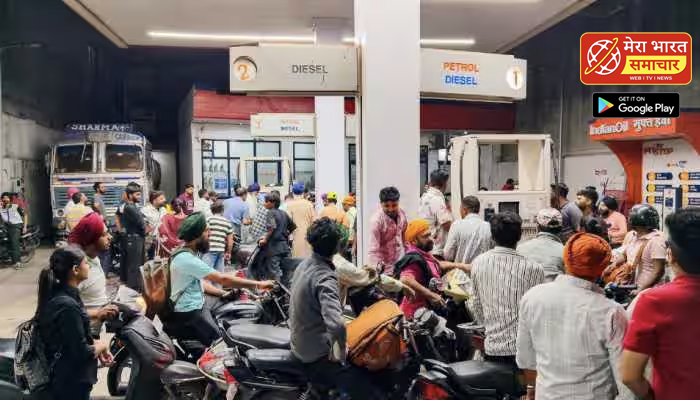
Government cuts excise duty by Rs 10 per litre on petrol and diesel amid the West Asia war
The government on Friday cut excise duty on petrol and diesel by Rs 10 per litre, reducing it to Rs 3 per litre on petrol and Rs 0 on diesel.
According to a government order dated Thursday, the excise duty on petrol has been reduced from Rs 13 per litre to Rs 3 per litre, a cut of Rs 10 per litre.
Likewise, the excise duty on diesel has been cut from Rs 10 per litre to Rs 0 per litre, also a reduction of Rs 10 per litre.
According to the Gazette notification. "In exercise of the powers conferred by section 5A of the Central Excise Act, 1944 (1 of 1944) read with section 147 of Finance Act, 2002 (20 of 2002), the Central Government, being satisfied that it is necessary in the public interest so to do, hereby makes the following further amendments in the notification of the Government of India in the Ministry of Finance (Department of Revenue), No. 05/2019-Central Excise, dated the 6th July, 2019, published in the Gazette of India, Extraordinary, Part II, Section 3, Sub-section(i), vide number G.S.R. 488(E), dated the 6th July, 2019, namely; In the said notification, I. in the Table, (i) against Sl. No. 1, in column (4), for the entry, the entry "Rs. 3 per litre" shall be substituted, (ii) against Sl. No. 2, in column (4), for the entry, the entry "Nil" shall be substituted."
The move comes as the global energy market reels from the US‑Israel war on Iran and Tehran’s blockade of the Strait of Hormuz, a key route that carries about 20–25 million barrels of oil and gas a day, roughly one‑fifth of the world’s supply.
Before the war, India imported 12–15 percent of that crude oil.
Global Crude prices ease
The move comes as global crude prices ease after a sharp spike tied to the West Asia conflict.
As of 8:40 am, Brent crude was trading at USD 106.63 per barrel, down 1.28 percent, while WTI crude stood at USD 93.50 per barrel, down 1.04 percent .
Recent comments from US President Donald Trump, saying talks with Iran are going “very well,” and that attacks will be paused, have helped soothe worries in the oil market.
The duty cut aims to pass on some of this relief to consumers and cushion the risk of a rise in fuel prices.
This move offers relief to oil marketing companies, which had been losing money on the retail side due to rising crude oil costs. Retail prices of petrol and diesel remain unchanged for now.
The Central Government has also introduced a new Special Additional Excise Duty on Aviation Turbine Fuel, with exemptions bringing the effective rate down to ₹29.5 per litre. The changes took effect from March 26.
Strait of Hormuz: A critical chokepoint
India imports large volumes of gas from West Asia, through the Strait of Hormuz, with an estimated 16–17 percent of LNG exported by Qatar and the United Arab Emirates going to Delhi.
In addition, India buys substantial quantities of LPG, liquefied petroleum gas, from Qatar and Iran via the Strait of Hormuz, supplying over 33 crore households.
This heavy dependence has raised fears of serious oil and gas shortages in the country due to the Iran war, but the government has said there is no immediate risk.
www.merabharatsamachar.com