Allegations of ₹13.74 Crore Mineral Fund Misappropriation in Poochampatti Panchayat – Shocking Findings from RTI Inspection
Allegations of ₹13.74 Crore Mineral Fund Misappropriation in Poochampatti Panchayat – Shocking Findings from RTI Inspection
In Poochampatti Village Panchayat, which falls under Vadipatti Taluk in Madurai District, documents indicating that ₹13.74 crore of mineral fund has been received and fully spent over the past seven years have sparked controversy.
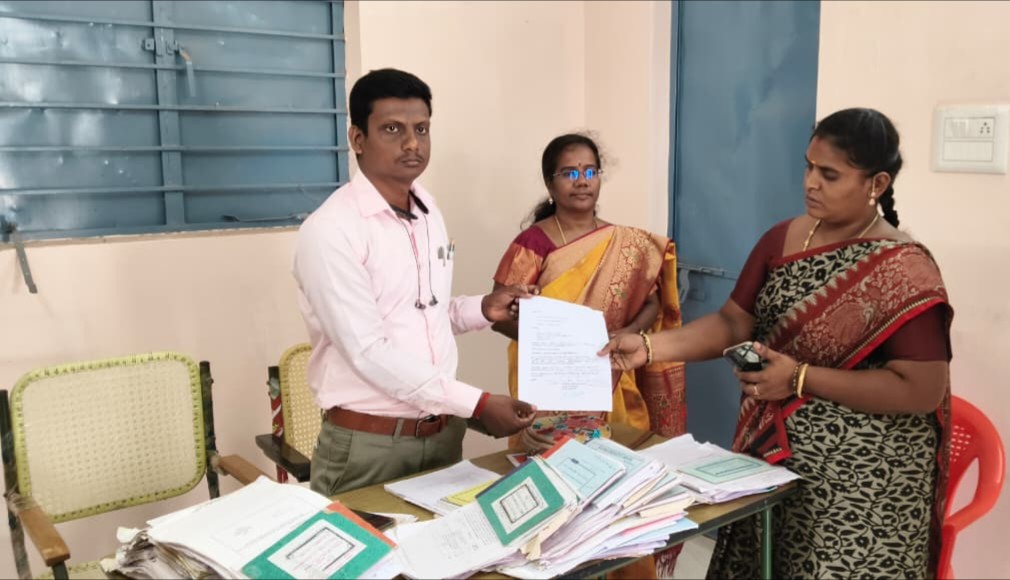
Under the Right to Information Act, social activist Gnanasekaran had applied seeking permission to directly inspect government records.
Accordingly, with police protection from the Vadipatti Police Station and accompanied by People Path District Coordinator Amudha, he conducted an inspection at the Panchayat office.
During the inspection, although records from 2005 to 2026 were requested, it was found that key documents prior to 2019 were not available in the office. Furthermore, records show that from 2019 to 2026, a total of ₹13,74,09,921 was received as mineral funds and the entire amount was shown as spent.
However, despite such a large amount reportedly being utilized, the social activist alleged that even basic infrastructure has not been fully developed in Poochampatti village. This has raised suspicions of possible financial irregularities.
It was also reported that officials initially attempted to prevent the photographing of documents during the inspection, but the inspection continued after citing Tamil Nadu Information Commission rules.
The public has demanded a high-level inquiry into the matter and strict action against the concerned officials if irregularities are confirmed.
If ₹13.74 crore had been properly and systematically utilized in Poochampatti village under Vadipatti Taluk, the village would have transformed into a modern model village today.
All internal roads would have been converted into quality tar or cement roads, with proper drainage systems to prevent water stagnation during the rainy season. Solar-powered streetlights would have ensured nighttime safety and energy efficiency.
In the field of education, government schools would have been upgraded into smart classrooms with computer labs and internet-enabled e-libraries, providing students with opportunities comparable to urban areas.
In the healthcare sector, purified drinking water would have been supplied to every household through pipelines, and a modern primary health center with 24-hour service would have been functioning, reducing the need for villagers to travel to cities for minor treatments.
In agriculture and livelihood, water bodies would have been desilted, increasing groundwater levels. Modern markets and cold storage facilities for farmers would have ensured better prices for produce and increased income. Local small-scale industries would have created employment opportunities.
Additionally, parks, playgrounds, and solid waste management centers would have been established, creating a clean and healthy environment.
Overall, if such an investment had been genuinely implemented, Poochampatti would have transformed from a village struggling for basic amenities into a self-sufficient and developed village with urban-level facilities.
However, in reality, the situation in Poochampatti is said to be completely different. In many areas, mud roads still exist, becoming slushy and impassable even with light rain. Due to the lack of drainage systems, wastewater stagnates on the streets, causing foul odors.
Drinking water supply is irregular, forcing women to struggle daily for water. In some areas, water is reportedly available only once a week.
Government schools still lack basic facilities, and provisions like computers and internet access exist only on paper. Youth are still compelled to migrate to cities for education and employment.
Due to inadequate healthcare facilities, even minor medical issues require people to travel several kilometers. The absence of permanent medical services in the village remains a major hardship.
Farmers are also affected due to water scarcity and lack of support infrastructure. Water bodies remain poorly maintained, leading to declining groundwater levels.
“Crores are shown as spent on paper, but we are still struggling for basic amenities,” villagers say with distress.
This has raised serious questions about where the ₹13.74 crore was actually spent, strengthening the demand among villagers for a transparent and comprehensive investigation.