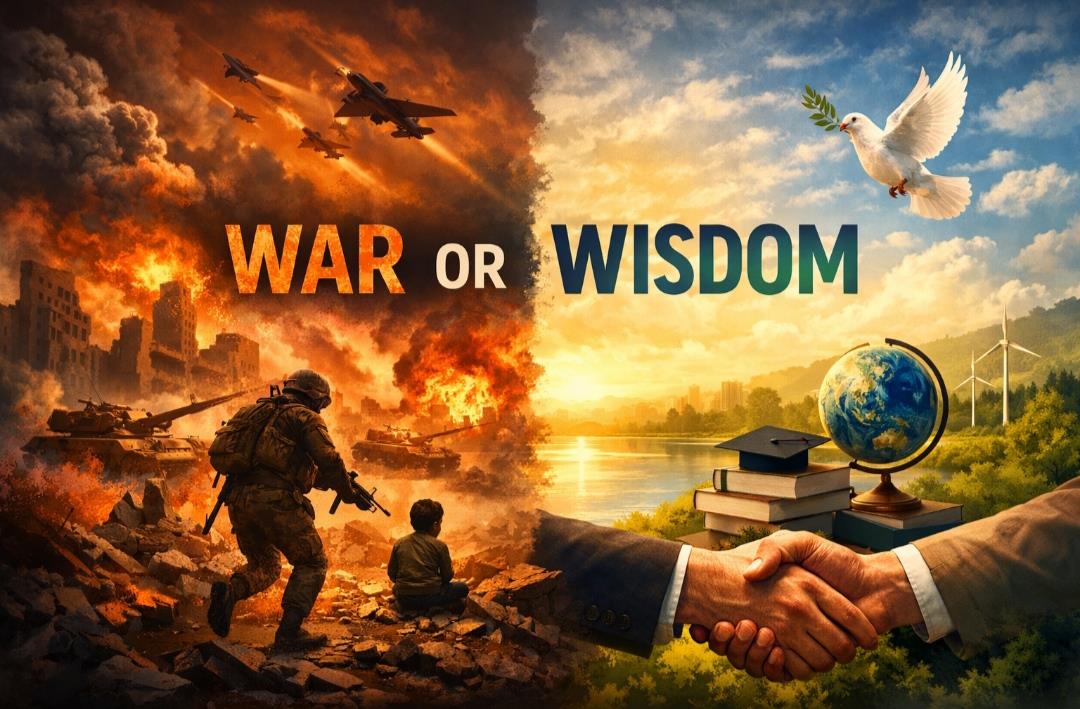
WAR OR WISDOM ?
A Civic Reflection on Peace in a Time of Global Crisis
By Subash Chandra Dash | Civic Lens
The twenty-first century was expected to be an age of technological progress, global cooperation, and shared prosperity. Yet the headlines of our time increasingly speak the language of conflict. From the war triggered by the Russian invasion of Ukraine to the devastating humanitarian crisis unfolding in the Gaza Strip during the Israel–Hamas war, the world seems trapped in a cycle where power is asserted through force rather than dialogue.
This raises a fundamental question for our time:
Is war still the language of power, or has humanity matured enough to choose peace as the language of wisdom?
The Illusion of Victory
History shows that wars rarely produce lasting victories. Empires may claim triumph, but societies often inherit trauma. Infrastructure can be rebuilt, but broken trust between communities takes generations to repair.
Modern warfare is no longer confined to battlefields. It spreads through economic sanctions, cyber conflicts, and information warfare. In such an environment, the line between victory and loss becomes increasingly blurred.
The Human Cost
The greatest victims of war are civilians. Families lose homes, children lose schools, and entire communities lose their sense of security.
When a child grows up under the sound of sirens and explosions, the future itself becomes uncertain. Every destroyed hospital, every ruined classroom, is a reminder that war attacks not only nations but the very foundations of human dignity.
The Responsibility of Global Institutions
The United Nations was founded with the hope that humanity would never again experience the devastation of global war. Yet the present moment reveals both the necessity and the limitations of international institutions.
The Secretary-General of the United Nations, António Guterres, has repeatedly urged world leaders to prioritize diplomacy over confrontation. His warnings highlight a difficult truth: peace requires continuous effort, patience, and political courage.
The Role of Civic Voices
Peace is not created only in diplomatic halls. It is also shaped by the voices of citizens, writers, educators, and journalists who question the narratives that normalize conflict.
Platforms like Civic Lens aim to contribute to this dialogue. By encouraging critical thinking and ethical reflection, civic media can remind societies that the pursuit of peace is not weakness—it is wisdom.
Choosing the Future
Human civilization stands at a decisive moment. Technological advancement has given humanity unprecedented power. The question now is whether this power will be used to deepen divisions or to build cooperation.
War may demonstrate strength for a moment.
Peace demonstrates wisdom for generations.
The future of humanity may depend on which of these two paths we choose.
Tags:
Global Politics
War and Peace
Civic Reflection
International Affairs
Human Rights