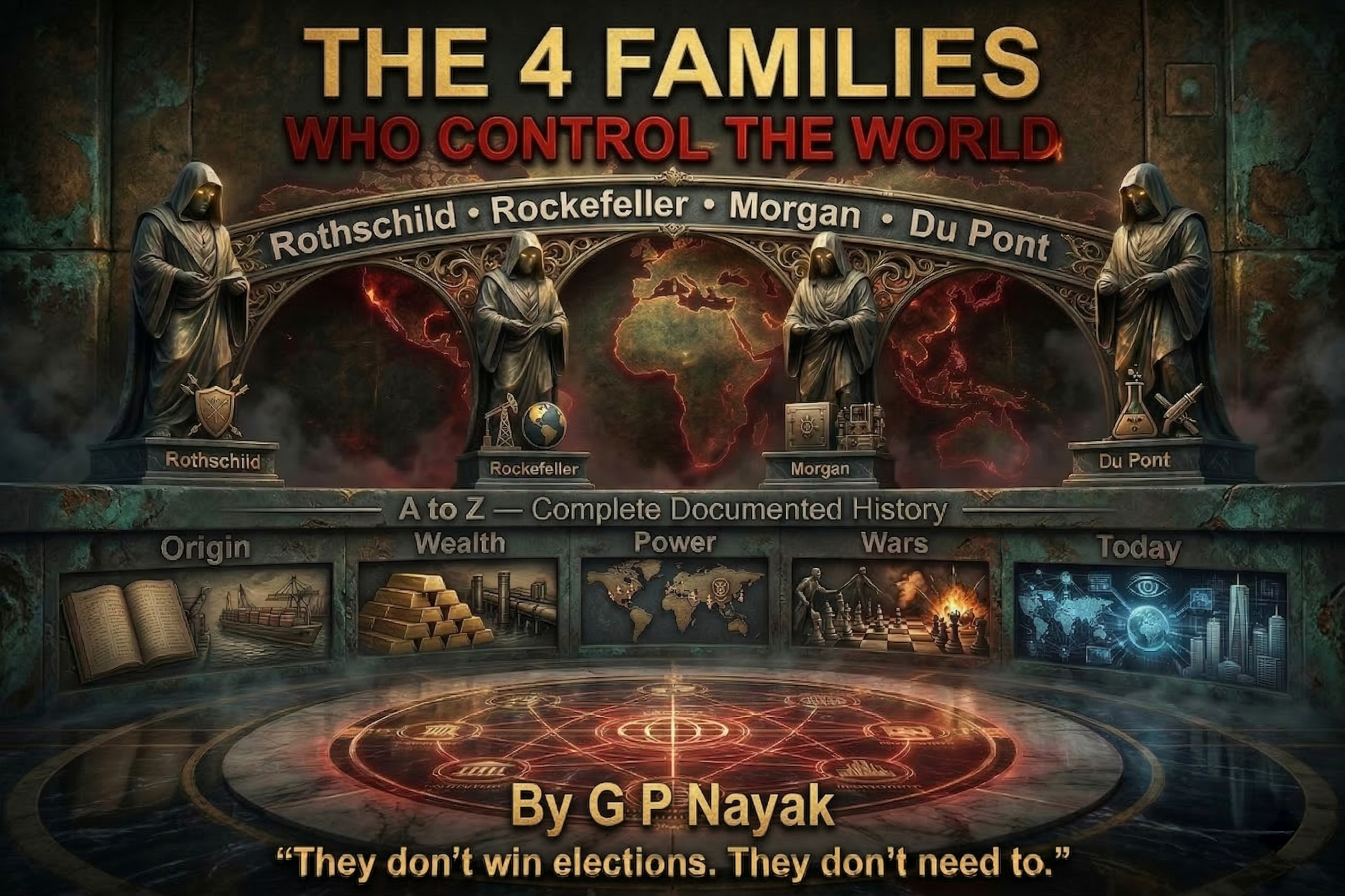
The Four Families who control the World
#The Invisible Empires#
*The Four Dynasties That Quietly Shaped the Modern World*
For more than two centuries, the architecture of global power has often traced back to a handful of extraordinary financial and industrial dynasties. Their names echo through the history of wars, revolutions, industrial booms, and financial crises. Banking, oil, chemicals, and capital markets—four pillars that built the modern world—were profoundly shaped by four families: the Rothschilds, the Rockefellers, the Morgans, and the Du Ponts.
These dynasties did not simply accumulate wealth. They built systems—networks of banks, industries, and institutions that became deeply embedded in the global economy.
This is the story of the families whose influence stretched across continents and centuries.
The Rothschild Dynasty – The Birth of Global Banking
In the narrow alleys of Frankfurt’s Jewish quarter in the eighteenth century, Mayer Amschel Rothschild began what would become one of history’s most legendary financial empires.
Born in 1744, Mayer Amschel built his early fortune trading coins and rare artifacts. His financial acumen soon earned the trust of European nobility, including the powerful William IX, Landgrave of Hesse-Kassel, one of the wealthiest rulers of the era.
But Rothschild’s greatest innovation was strategic. Rather than concentrating power in one city, he dispatched his five sons across Europe’s financial capitals—Frankfurt, London, Paris, Vienna, and Naples. This network created what historians often describe as the first truly international banking system.
During the Napoleonic Wars, this family network enabled rapid transfer of capital and information across borders. Governments and monarchies relied on their financial services to fund armies, rebuild economies, and stabilize national treasuries.
By the nineteenth century, the Rothschild banking houses were financing major infrastructure projects—from railways and mining ventures to sovereign government loans. Their financial reach extended across the European continent and beyond.
Today, their legacy survives through Rothschild & Co, an influential global financial advisory firm serving governments and multinational corporations.
The Rockefeller Empire – Oil and the Rise of Industrial Power
If the Rothschild story is one of banking, the Rockefeller story is the story of oil.
In 1870, John D. Rockefeller founded Standard Oil in Cleveland, Ohio. At the time, the oil industry was chaotic and fragmented. Rockefeller saw opportunity where others saw volatility.
Through relentless efficiency, strategic acquisitions, and aggressive price competition, Standard Oil expanded rapidly. By the 1880s the company controlled roughly 90 percent of oil refining in the United States.
The monopoly triggered a historic legal battle. In 1911, the U.S. Supreme Court ordered Standard Oil to be dismantled into multiple companies under antitrust laws. Yet the breakup paradoxically expanded Rockefeller wealth, as he retained shares in the newly independent firms.
These companies later evolved into some of the world’s largest energy corporations, including ExxonMobil and Chevron.
Beyond oil, the Rockefellers built enormous philanthropic influence through the Rockefeller Foundation, funding universities, global health programs, and scientific research institutions. Their contributions helped shape modern public health, medical research, and agricultural development worldwide.
The Morgan Network and the Era of Financial Titans
As the United States industrialized in the late nineteenth century, another financial titan rose to prominence: J. P. Morgan.
Morgan specialized in consolidating industries and stabilizing financial markets during periods of economic turmoil. His influence extended across railroads, steel, banking, and insurance.
In 1901, he engineered the creation of United States Steel Corporation, the first corporation in history valued at over one billion dollars.
Morgan’s influence reached its peak during the Panic of 1907, when the American financial system teetered on the brink of collapse. Without a central bank to intervene, Morgan personally coordinated a rescue effort among leading bankers to stabilize the economy.
The crisis ultimately contributed to the establishment of the Federal Reserve System in 1913, fundamentally reshaping American financial governance.
More than a century later, global financial influence has increasingly shifted toward large institutional asset managers. Among the most powerful is BlackRock, founded in 1988 by Larry Fink.
Managing trillions of dollars in investments on behalf of pension funds, governments, and institutional investors, BlackRock has become one of the most influential financial firms in the modern world.
The Du Pont Dynasty – Chemistry and the Industrial Age
The fourth pillar of industrial power emerged from chemistry and manufacturing.
The Du Pont story began in 1802 when French immigrant Éleuthère Irénée du Pont established a gunpowder mill in Delaware.
Initially supplying explosives to the young United States government, the company expanded rapidly and became a dominant force in chemical manufacturing.
Throughout the twentieth century, DuPont pioneered materials that revolutionized industry, including nylon, Teflon, and Kevlar.
These innovations transformed sectors ranging from aerospace and defense to consumer products and textiles.
DuPont’s influence extended far beyond manufacturing, intertwining with political networks, research institutions, and major industrial partnerships.
---
Networks, Influence and the Global Economy
The stories of these four dynasties reveal how finance, industry, and innovation combined to shape modern capitalism.
Their influence spanned:
- International banking networks
- Industrial monopolies
- Corporate consolidation
- Scientific and technological innovation
Yet the global economy today is far more complex than any single family or network.
Modern financial power is distributed across governments, multinational corporations, central banks, and enormous institutional investors.
Among the most influential today are global asset managers such as BlackRock, Vanguard Group, and State Street Corporation, which collectively manage tens of trillions of dollars in assets worldwide.
The Legacy
The Rothschilds engineered the first international banking networks.
The Rockefellers built the oil empire that fueled the industrial revolution.
The Morgans shaped modern finance and corporate consolidation.
The Du Ponts transformed chemistry and industrial manufacturing.
Together, their legacies helped construct the economic and industrial systems that continue to power the modern world.
Their stories remain among the most fascinating chapters in the history of global capitalism.