From Ashrams to Assemblies: The Political Empire of India’s Dharma Gurus
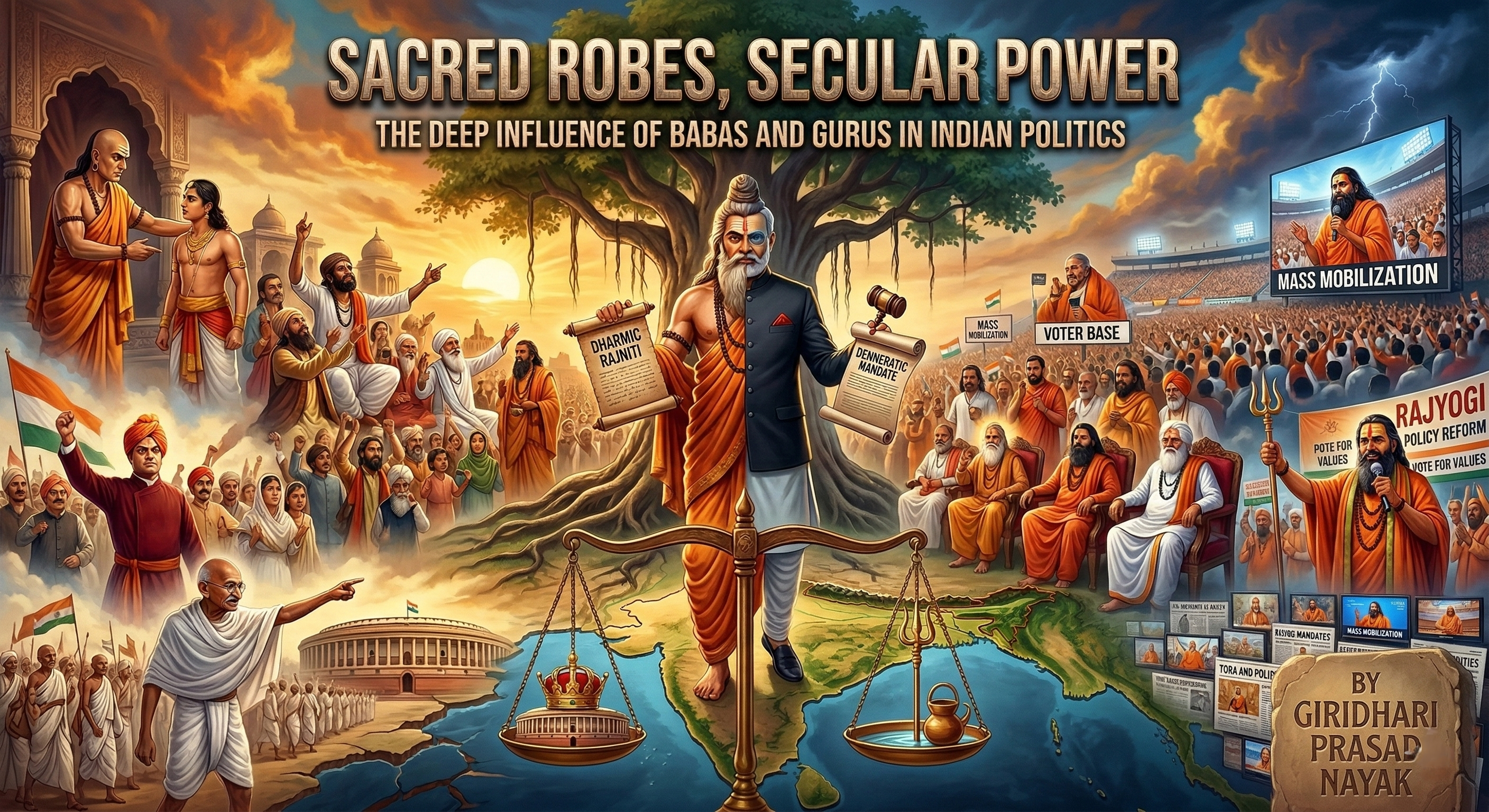
Sacred Robes, Secular Power: The Deep Influence of Babas and Gurus in Indian Politics
India, often described as a civilization rather than merely a nation-state, has always existed at the intersection of spirituality and governance. From ancient rishis guiding kings to modern-day godmen shaping electoral narratives, the presence of spiritual figures in political spaces is neither accidental nor recent. The relationship between dharma gurus and political authority is deeply embedded in India's historical psyche, where spiritual legitimacy often strengthens temporal power.
Ancient Roots: When Rishis Guided Kings
In ancient India, governance was rarely detached from spiritual counsel. Kings frequently relied on sages for guidance in matters of statecraft, ethics, and warfare. Figures such as Chanakya played a decisive role in shaping political history. As the mentor of Chandragupta Maurya, Chanakya combined philosophical wisdom with ruthless political strategy to establish one of the most powerful empires in ancient India.
Similarly, the influence of sages like Vasistha and Vishwamitra in mythological and historical narratives reveals a longstanding tradition where rulers sought legitimacy through spiritual endorsement.
In this era, gurus were not merely religious teachers—they were custodians of moral authority capable of guiding kings toward what was perceived as righteous governance.
Medieval India: Spiritual Networks and Political Legitimacy
During the medieval period, the influence of spiritual leaders expanded into mass movements. Bhakti and Sufi saints mobilized large followings, indirectly shaping political landscapes. Saints like Guru Nanak and later Guru Gobind Singh transformed spiritual communities into powerful socio-political forces.
The creation of the Khalsa by Guru Gobind Singh in 1699 was not merely a religious event; it was a revolutionary restructuring of community identity that challenged imperial authority and laid the foundation for Sikh political power in northern India.
Similarly, the spiritual authority of Sufi saints often translated into social influence that rulers sought to cultivate or neutralize.
Colonial India: Spiritual Leaders as Political Catalysts
During British rule, spiritual figures became symbols of resistance and national awakening. One of the most influential personalities of this period was Swami Vivekananda, whose speeches inspired a generation of nationalists to reclaim cultural pride and self-confidence.
Another towering figure was Sri Aurobindo, who began as a revolutionary political activist before transitioning into a spiritual philosopher whose ideas influenced India's intellectual and political discourse.
Perhaps the most powerful fusion of spirituality and politics was embodied by Mahatma Gandhi. Though not a conventional guru, Gandhi’s political leadership drew heavily from spiritual principles such as ahimsa (nonviolence) and satyagraha (truth-force), turning moral philosophy into a formidable political weapon against colonial rule.
Post-Independence India: The Rise of Political Godmen
In modern India, the role of gurus evolved dramatically with the rise of mass media, electoral democracy, and personality cults. Spiritual leaders with millions of followers became influential actors capable of swaying public opinion and sometimes even electoral outcomes.
Figures such as Dhirendra Brahmachari gained extraordinary proximity to political power during the era of Indira Gandhi, illustrating how spiritual advisors could influence decision-making at the highest levels of government.
Later decades saw controversial godmen like Chandraswami whose connections reportedly extended to politicians, businessmen, and international figures.
The phenomenon continued into the 21st century with figures like Baba Ramdev, who transitioned from a yoga instructor into a powerful socio-political voice advocating policy changes and mobilizing public opinion on issues ranging from corruption to economic nationalism.
Another striking example is Yogi Adityanath, a monk-turned-politician whose rise represents the direct institutional entry of religious leadership into electoral politics.
Why Gurus Hold Political Power
The influence of gurus in Indian politics stems from several structural factors:
1. Moral Authority:
Spiritual leaders command trust among followers who view them as custodians of truth and ethics.
2. Mass Mobilization:
Large religious congregations and ashrams function as ready-made networks capable of mobilizing millions.
3. Cultural Legitimacy:
In a deeply spiritual society like India, endorsement from religious figures often provides symbolic legitimacy to political leaders.
4. Media Amplification:
Modern television channels, digital platforms, and religious events broadcast spiritual leaders to massive audiences, transforming them into national influencers.
The Double-Edged Sword
While the presence of spiritual voices in public life can inspire ethical governance, it also raises concerns about the blurring of lines between religion and state. Critics argue that excessive political involvement by gurus risks undermining secular democratic institutions.
At the same time, supporters contend that moral leadership rooted in spiritual values can provide a counterbalance to corruption and materialism in politics.
Conclusion: A Relationship That Will Endure
India’s political landscape cannot be fully understood without acknowledging the enduring influence of its spiritual figures. From the strategic brilliance of Chanakya to the modern political mobilization of contemporary gurus, the alliance between sacred authority and secular power has repeatedly shaped the nation’s trajectory.
In India, politics and spirituality are not isolated spheres. They are threads woven into the same civilizational fabric—sometimes harmoniously, sometimes controversially, but always powerfully.
The question, therefore, is not whether gurus will influence politics. The real question is how responsibly that influence will be exercised in the world's largest democracy.