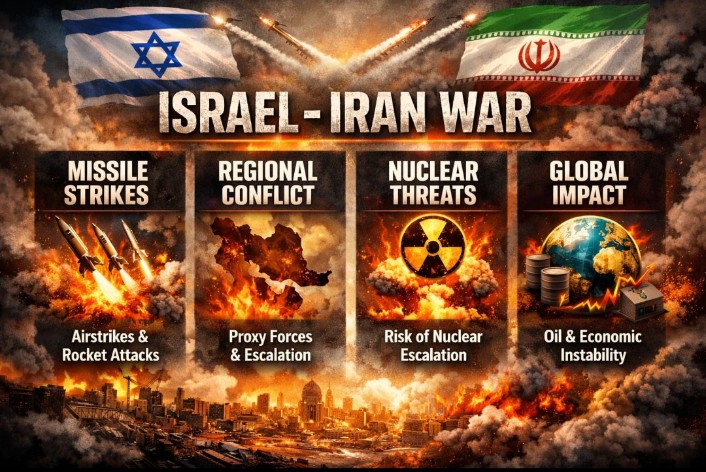
Unfolding conflict in Middle East became a War Zone. Tension , consequences as of March 2026
In the latest developments of the war between Israel and Iran, involving strong support from the United States, the crisis has expanded into a broader regional conflict with significant geopolitical, economic, and humanitarian consequences. The conflict began when joint U.S.–Israeli forces launched major strikes on Iranian military and strategic infrastructure late last week, killing key leaders including Iran’s Supreme Leader and damaging command and control facilities across Tehran and other cities. Iran has responded with widespread missile and drone attacks on Israeli territory, U.S. bases, and allied Gulf states, while proxy groups such as Hezbollah in Lebanon have intensified their attacks on northern Israel.
Humanitarian and military impact
The war has already caused hundreds of casualties: Iranian officials and independent estimates put the death toll in Iran in the high hundreds, including civilians, while dozens of deaths have been reported in Lebanon and Israel. U.S. forces have also suffered casualties, including service members killed in strikes on a facility in Kuwait and a U.S. submarine recently sunk an Iranian warship – a rare and dramatic escalation marking the first such torpedo engagement by U.S. forces since World War II.
Regional escalation and diplomatic fallout
Iran’s retaliation has not been limited to Israel. Iranian missile and drone strikes have hit Gulf states such as Bahrain, Kuwait, and even areas near Cyprus, prompting emergency responses from NATO forces, including interceptions in Turkish airspace. Proxy groups aligned with Iran are actively engaging Israeli positions across Lebanon and Syria, signaling the conflict’s spillover across the Levant.
At the United Nations Security Council, sharp divisions emerged when the U.S. and Israel defended their military actions as lawful self-defense, while Russia, China, and Iran condemned the strikes as illegal and called for an immediate ceasefire. The Council ended in deadlock without unified action, increasing global concerns about prolonged escalation.
Economic and global impact
The war has already disrupted global energy markets. The Strait of Hormuz, a critical maritime chokepoint for roughly 20 % of global oil exports, has seen significant shipping disruptions, pushing oil prices sharply higher and rattling international markets. Israel’s economy is also feeling the strain: closures, restricted travel, and reserve mobilization are costing billions per week, with public life heavily affected.
Broader consequences
Analysts warn the conflict could trigger wider instability across the Middle East, fuel refugee flows, and deepen geopolitical rivalries. Diplomatic efforts continue, but with both sides digging in and global powers divided, an immediate end to hostilities remains uncertain.