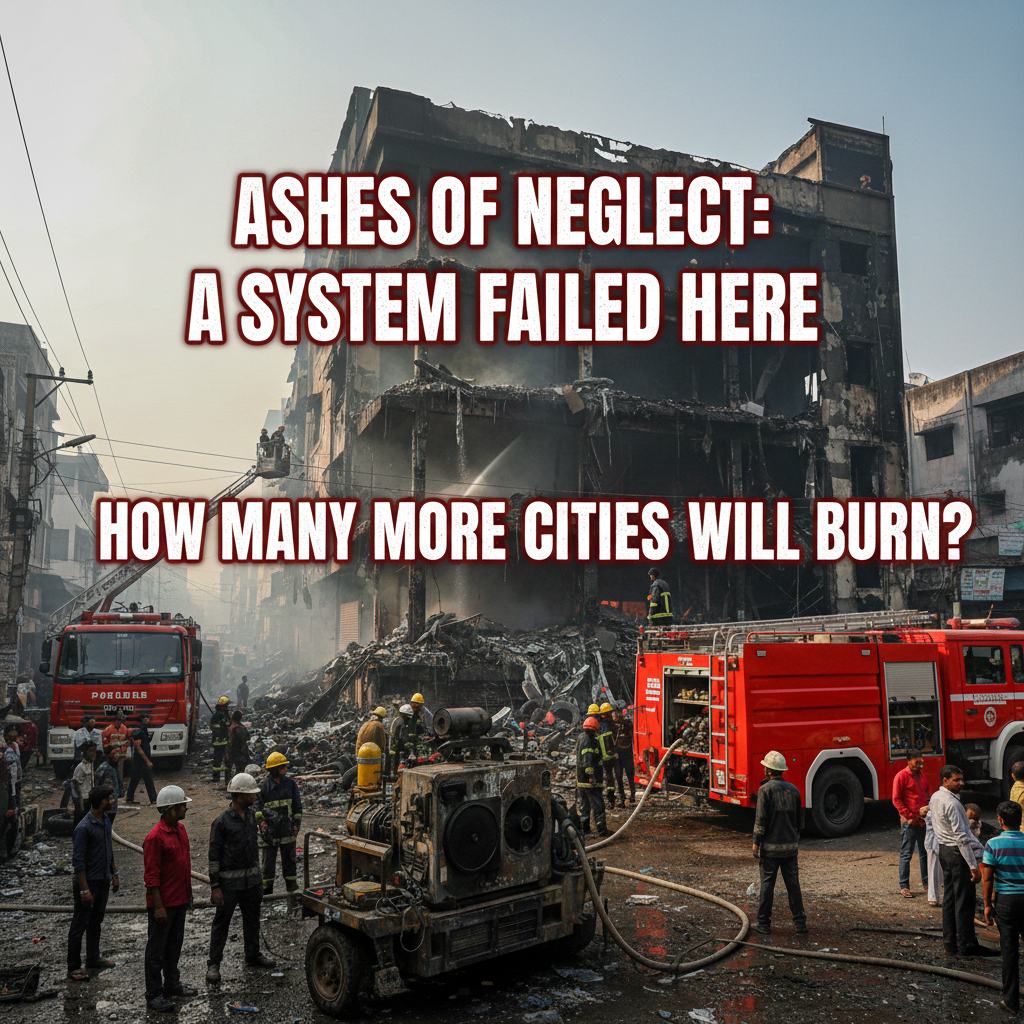
“No Deaths, No Excuse: The Lingipur Fire and System's Broken Safety Measures are Questionable”
The devastating fire that tore through a four-storey market in Bhubaneswar is not merely an isolated urban accident—it is a stark and uncomfortable reminder of systemic failure. The blaze, which raged for over 12 hours in the Lingipur area, exposed deep cracks not just in the building’s structure, but in the preparedness, regulation, and emergency response mechanisms of a rapidly expanding city.
While officials have confirmed that no lives were lost, the absence of casualties should not be mistaken for success. The incident highlights a dangerous pattern seen across Odisha and much of India—a reactive system that depends more on luck than on robust planning. The fact that firefighters had to drill holes into the structure to release smoke points to a fundamental lapse in building design compliance. Markets storing highly combustible materials such as plastic and rubber were allowed to operate in enclosed spaces with poor ventilation and inadequate fire exits. This is not an oversight; it is negligence embedded within the system.
The deployment of around 40 fire tenders and even a robotic firefighting unit may appear impressive on paper, but the prolonged duration of the fire raises serious questions about operational efficiency and technological adequacy. Reports indicate that the robotic system struggled due to extreme heat and dense smoke—conditions that modern firefighting robots in developed nations are specifically engineered to withstand. In countries like the United States, Japan, and Germany, fire response units are equipped with high-temperature-resistant robots, thermal imaging systems, automated sprinkler integrations, and advanced ventilation control mechanisms that drastically reduce firefighting time and risk. The contrast is glaring.
Budgetary allocation further reveals the depth of the issue. Fire services in India remain one of the most underfunded emergency sectors relative to urban growth. Despite increasing commercial density and hazardous storage practices, capital investment in modern firefighting infrastructure, training, and compliance auditing has not kept pace. In many developed nations, fire safety is treated as critical urban infrastructure, with strict enforcement of building codes, mandatory fire audits, and heavy penalties for violations. In contrast, enforcement in Indian cities often becomes reactive, surfacing only after disasters occur.
Equally troubling is the lack of accountability. How did a four-storey commercial structure storing flammable materials pass safety inspections? Why were there insufficient windows, exit points, and ventilation systems? These are not technical failures alone—they are administrative failures. Regulatory bodies, municipal authorities, and safety inspectors must share responsibility for allowing such vulnerabilities to persist.
The Bhubaneswar fire should serve as a wake-up call, not just for Odisha but for the entire country. Urbanisation without enforcement is a recipe for disaster. Fire departments cannot be expected to compensate for structural and regulatory failures with limited tools and delayed upgrades. If anything, this incident underscores the urgent need for policy reform, increased funding, adoption of global firefighting standards, and strict accountability mechanisms.
Until then, every similar market, warehouse, and commercial building across India remains a potential disaster waiting to unfold. The flames in Lingipur may have been extinguished, but the larger systemic fire continues to burn unchecked.