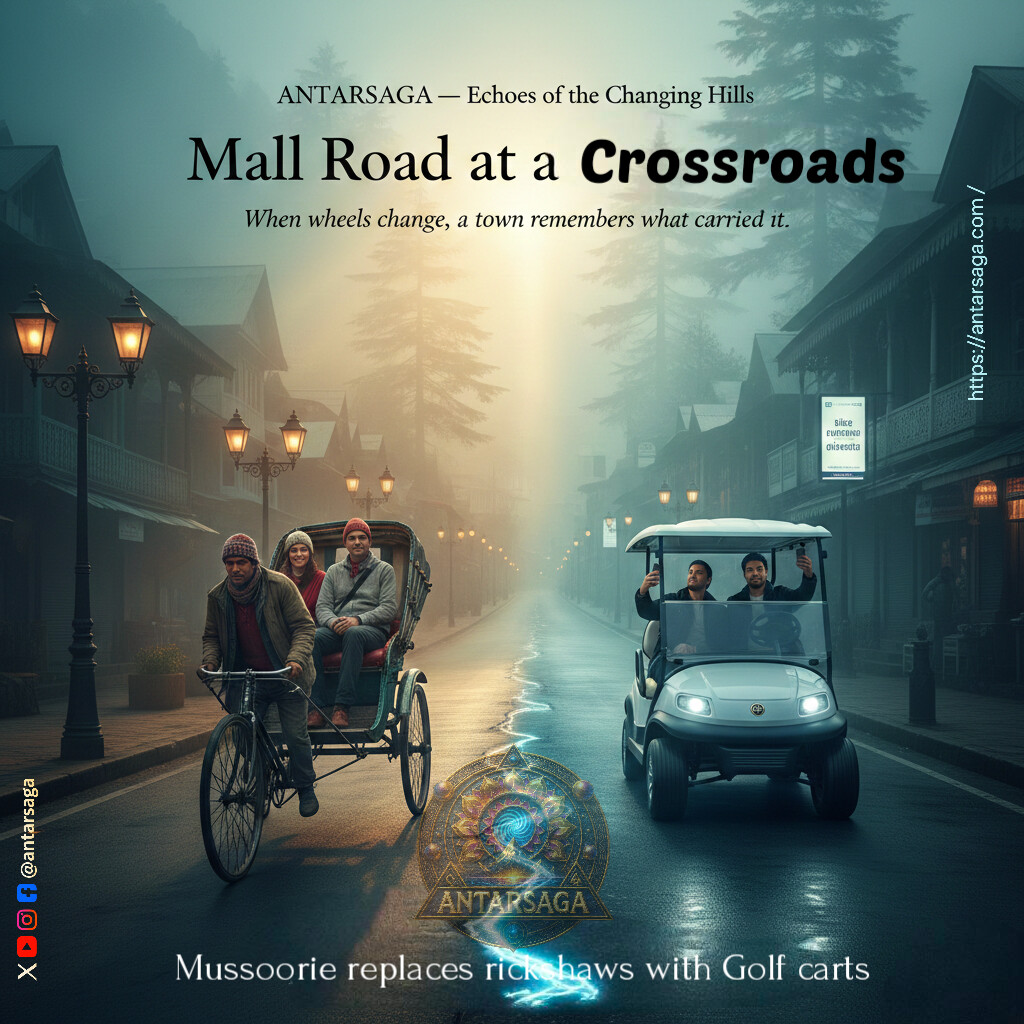
“Mall Road at a Crossroads” - From Rickshaws to Golf Carts: Mussoorie Faces a Defining Mobility Shift
The iconic Mall Road of the Queen of the Hills is set for a significant transformation. The proposed replacement of traditional cycle rickshaws with battery-operated golf carts has now moved beyond discussion into administrative action.
According to a report published in The Hills of Mussoorie by Pradeep Bhandari, an MOU between the District Administration and REC Foundation is expected to be signed this month to facilitate the operation of additional golf carts in town.
Earlier, Mussoorie Municipal Council Executive Officer Gaurav Bhasin had confirmed that around 40 golf carts would be introduced in a phased manner. Simultaneously, a rehabilitation and compensation framework is being prepared for approximately 121 registered rickshaw workers whose livelihoods depend on the existing system.
As administrative backing strengthens, public debate across Mussoorie has intensified — revealing both optimism and anxiety.
Modernization vs. Livelihood
Social worker Nidhi Bahuguna strongly supported the transition.
“India is changing and I am glad golf carts are replacing rickshaws. In the 21st century, when e-rickshaws are replacing human-driven rickshaws, this is a welcome step. Best use of technology — to free humans from driving other humans for survival.”
She further emphasized the need for viable local transport:
“The rickshaw wallas are getting the golf carts. We should have monthly passes for locals. It should extend beyond Mall Road — especially during school hours. There should be golf carts at Civil Hospital. Local transport is a crying need.”
She also highlighted the current transport challenges:
“Taxis charge ₹300 per person from Big Bend to Kulri Barrier. School children, often minors or without learner’s licences, are tripling on scooties while going to school in uniform. We need small travellers where golf carts can’t operate, and golf carts as final-mile transport.”
When asked about the number of rickshaws, Bahuguna stated:
“I think about 125 or so operate. Many are non-registered.”
However, employment concerns remain central.
Peter Gantzer questioned:
“What happens to the employment that is killed by these golf carts?”
He later remarked with characteristic wit:
“Picture a stampede of 125 golf carts ‘thundering’ through the Mall at a blistering speed — it won’t be a disaster, just a masterclass in gentle chaos and pedestrian insurance claims. We should immediately start planning functioning first aid centres on the Mall.”
Safety, Capacity & Infrastructure Concerns:
Local trader Saurabh Singhal raised practical questions:
“Where will these golf carts be parked? Running so many carts will ruin the beauty of Mall Road. Drivers already drive recklessly and carry passengers beyond capacity. If an accident happens, who will be responsible? The golf carts neither have insurance nor commercial permits. Only 2–3 carts should be allowed strictly for senior citizens and differently-abled people.”
Resident Pranav Sahni added:
“Can the Mall Road take 40 more golf carts? Or are other routes proposed as well?”
Another citizen noted:
“Routes and charges have to be streamlined and nominal. The present ₹80 for a short distance is quite high.”
Concerns about charging infrastructure were also voiced:
“There is no EV charging point in Mussoorie. Where will these vehicles charge?”
Businessman Vikas Hari warned:
“Masterclass in silent chaos. Scooties and rickshaws at least make noise for one to get aside. Silent engines mean silent accidents. By 2027 we may see more golf carts coming. The whole purpose of cleaning up the Mall from hawkers gets defeated.”
Operational Planning & Route Design:
Businessman Sandeep Sahni (Brentwood) suggested structured implementation rather than outright opposition:
“Golf carts are a good idea, but routes, operations and numbers need to be streamlined. The initial plan was to have them run in a one-way loop within the Mall and Camel’s Back Road, with Hawa Ghars as pit stops — like a hop-on hop-off service. Free for local residents, but with an annual permit fee paid to NPP. That permit fee money should be distributed to operators or used for maintenance. Major earnings should come from tourists."
He also added:
“From my limited understanding, golf carts can’t operate on highways. If that is the case, it severely restricts their movement space.”
Public Transport Vacuum:
Raj Bijalwan, a Landour resident and long-time Mussoorie admirer, observed:
“Mussoorie seriously lacks a public mode of transport. With growing tourist vehicles, parkings should be used and golf carts or local taxis used for travelling within town. Regulated and extended golf carts will be helpful for local citizens. With monthly passes and incentives, they can be assimilated into daily life.”
He clarified that his remarks were personal observations made with limited knowledge of policy constraints.
Infrastructure Before Expansion?
Resident Vikram Zutshi pointed to the condition of surrounding routes:
“For tourists it will become an adventurous ride on Camel’s Back — potholes, gravel, broken stretches everywhere. Another attraction added to Mussoorie…”
He added sarcastically:
“Beautiful sighting of dumped trash, very friendly dog gangs and stinking washrooms — wah.”
A Deeper Question for the Hills:
For decades, human-powered cycle rickshaws have not merely been transport — they have been part of Mussoorie’s visual and social identity.
The proposed District Administration–REC Foundation MOU signals that this is no longer a minor pilot but potentially a larger structural shift.
Supporters see dignity, modernization and necessary urban adaptation.
Skeptics see congestion, safety hazards, heritage erosion and uncertain rehabilitation.
At its core, the debate is larger than golf carts.
It is about the character of a hill town negotiating 21st-century pressures.
As Mussoorie weighs mobility against memory, regulation against spontaneity, and progress against preservation, one reality stands clear:
Mall Road is not just changing its wheels — it is redefining its rhythm.
The debate, it seems, has only begun.