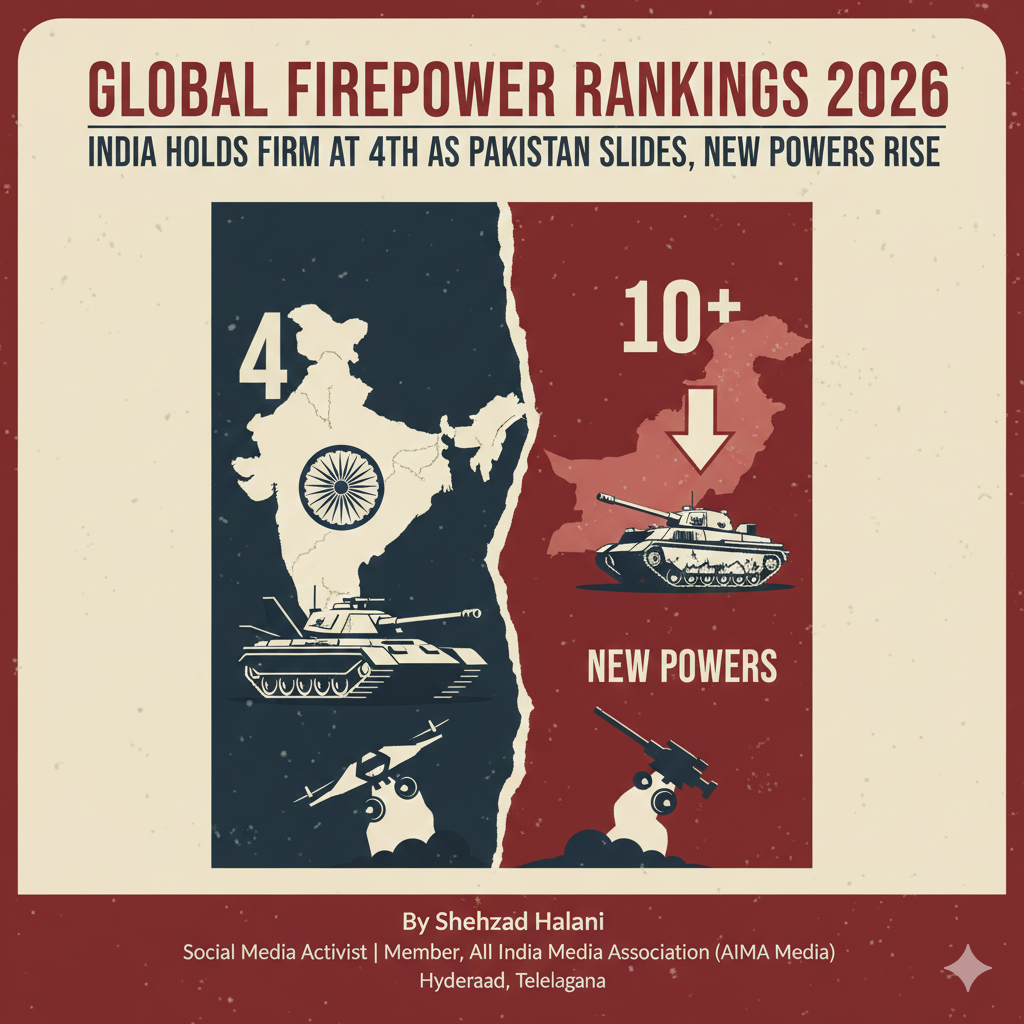
Global Firepower Rankings 2026: India Holds Firm at 4th as Pakistan Slides, New Powers Rise
The 2026 Global Firepower Index has reaffirmed the existing global military hierarchy, but significant regional shifts are reshaping the strategic landscape. While the top four military powers remain unchanged, emerging players and declining forces are redrawing the balance across Asia and the Middle East.
Top 4 Stay the Same, But Gaps Remain
The United States continues to dominate global military rankings, followed by Russia in second place, China in third, and India firmly in fourth. Despite China’s ongoing military modernization and restructuring, it has not yet overtaken Russia in overall capability.
However, analysts point out a structural weakness in India’s military growth trajectory: defense R&D spending. India currently allocates only about 5% of its defense budget to research and development, compared to 10–15% by the US and China. Experts argue that without a significant boost in indigenous defense innovation, India may struggle to break into the top three in the coming decade.
Pakistan’s Sharp Fall, Israel’s Steady Rise
One of the most dramatic developments in the 2026 rankings is Pakistan’s decline to 14th place, a steep fall from its peak position of 7th in 2023. Analysts attribute this drop to strategic stagnation and the long-term impact of recent military setbacks, which disrupted Pakistan’s upward trajectory.
In contrast, Israel has climbed steadily to 15th place, now just behind Pakistan. With its rapid technological advancements and strong defense ecosystem, Israel is seen as a rising force. Some strategic observers believe that a decisive military edge over regional adversaries could push Israel even higher in future rankings.
Indonesia Emerges as an Indian Ocean Power
A notable new entrant in the regional power equation is Indonesia, which has surged ahead in military capability. Strengthening its arsenal with French Rafale fighter jets and securing a $450 million BrahMos missile deal with India, Indonesia is positioning itself as a serious strategic actor in the Indian Ocean Region.
This shift signals a broader trend of middle powers modernizing rapidly, altering traditional regional balances.
Saudi Arabia’s Unexpected Decline
While some nations rise, others fall. Saudi Arabia has dropped sharply to 25th place, marking one of the steepest declines in the rankings. Experts suggest that defense partnerships lacking technological depth and operational efficiency have limited Riyadh’s military growth, despite its large defense budget.
Regional Shifts Across Asia
Iran now stands at 16th, falling behind Israel in overall strength.
Bangladesh’s ranking has slipped, while Myanmar is assessed as militarily stronger than before.
North Korea continues to quietly improve its military standing, driven by missile and nuclear advancements.
Data vs. Media Narratives
The rankings also challenge certain international media narratives that previously questioned India’s military preparedness. While some opinion pieces claimed regional operations exposed weaknesses, the Global Firepower data shows India maintaining its strong 4th position, even as rivals like Pakistan slide down.
A Changing Strategic Landscape
The 2026 rankings underscore a world where military power is increasingly tied to technology, indigenous innovation, and strategic modernization rather than just troop numbers or legacy systems. For India, the message is clear: maintaining its position among the top four powers is an achievement, but moving higher will require a decisive push in defense R&D and next-generation warfare capabilities.
As emerging powers rise and traditional players fluctuate, the global military balance is entering a new phase — one defined by innovation, adaptability, and long-term strategic vision.