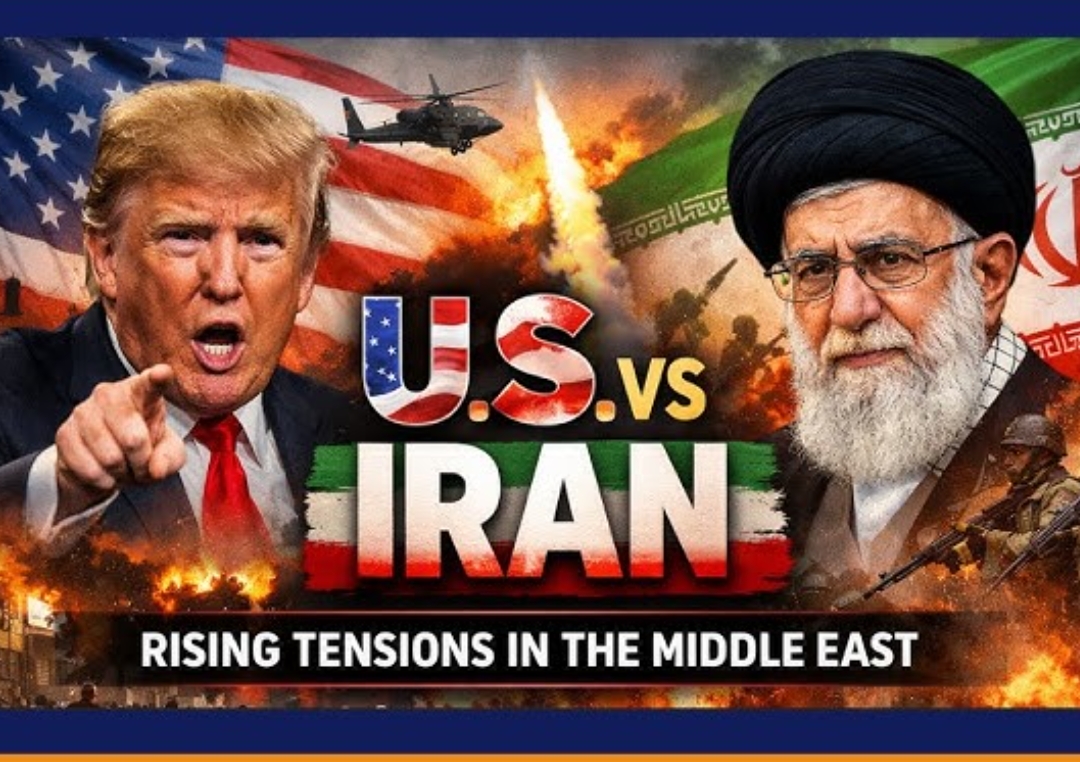
Iran–USA Conflict: Strengths, Limitations, and Strategic Reality
Recent tensions between Iran and the United States have again raised questions about what would happen if a direct war were to break out. While both countries possess significant military capabilities, the balance of power is highly asymmetrical. In a conventional, state-to-state conflict, the United States would almost certainly prevail due to overwhelming advantages in technology, air power, naval dominance, global logistics, and economic capacity. However, such a war would still be costly, complex, and destabilizing for the entire region.
The United States maintains the most powerful military in the world. Its defense budget alone is larger than that of the next several countries combined, allowing sustained investment in advanced weapons, training, intelligence systems, and global force projection. The U.S. military is structured to fight and win wars far from its homeland, supported by a worldwide network of bases, allies, and supply chains. Iran, by contrast, has a much smaller defense budget and focuses primarily on regional defense and deterrence rather than global operations.
One of the biggest deciding factors in a U.S.–Iran war would be air superiority. The United States operates thousands of modern aircraft, including fifth-generation stealth fighters, long-range bombers, aerial refueling tankers, and advanced surveillance drones. This would allow the U.S. to rapidly suppress Iranian air defenses, destroy radar systems, and gain control of Iranian airspace. Iran’s air force is comparatively limited, relying largely on older aircraft with restricted maintenance and modernization due to decades of sanctions. Without control of the skies, Iran would struggle to defend key military infrastructure.
Naval power is another area of clear U.S. dominance. The U.S. Navy possesses multiple aircraft carrier strike groups, nuclear-powered submarines, and long-range cruise missiles capable of precision strikes. This allows the U.S. to project power from the sea without relying heavily on ground troops. Iran’s navy is designed mainly for coastal and regional operations, particularly in the Persian Gulf and Strait of Hormuz. While Iran could disrupt shipping and harass U.S. vessels using fast boats, mines, and missiles, it cannot match the U.S. Navy in open or sustained combat.
Iran’s real strength lies in asymmetric warfare rather than conventional battles. It has a large arsenal of ballistic and cruise missiles capable of striking U.S. bases and allied targets in the Middle East. Iran has also invested heavily in drones, cyber warfare, and regional proxy forces. These tools would likely be used to retaliate against U.S. strikes, increase regional instability, and raise the cost of war for Washington and its allies. Such actions could prolong the conflict and expand it beyond Iran’s borders.
Despite these capabilities, Iran’s economic and industrial limitations significantly reduce its ability to sustain a long, high-intensity war. U.S. forces can replace equipment, produce munitions at scale, and rotate troops over extended periods. Iran, facing sanctions and limited access to advanced technology, would find it difficult to maintain prolonged conventional resistance once major military assets are degraded.
For these reasons, most defense analysts agree that the United States would win a conventional military conflict against Iran. It would likely achieve its objectives through air and naval strikes rather than a full ground invasion, minimizing U.S. casualties while degrading Iran’s military capabilities. However, winning militarily does not necessarily mean achieving long-term stability or political success.
A war between Iran and the United States would carry serious risks, including civilian casualties, regional escalation, disruption of global energy markets, and prolonged instability driven by proxy conflicts. Even though the U.S. holds decisive military advantages, the consequences of such a conflict would extend far beyond the battlefield, making it a scenario that most policymakers seek to avoid.