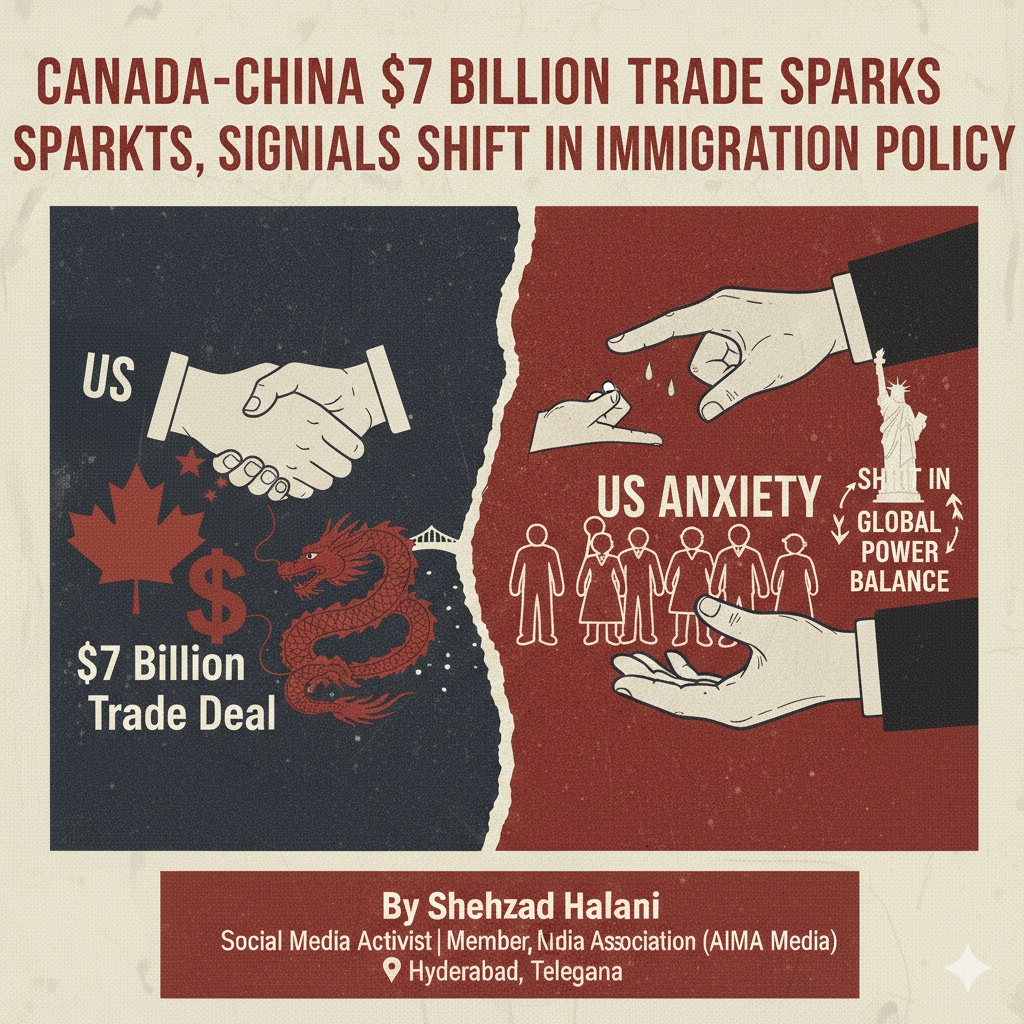
Canada–China $7 Billion Trade Deal Sparks US Anxiety, Signals Shift in Global Power Balance
Canada’s recent $7 billion trade agreement with China has triggered unease in Washington, exposing growing cracks in traditional Western alliances and highlighting a broader shift in the global geopolitical order. The deal, covering key sectors such as agriculture, energy, finance, and electric vehicles, comes at a time when America’s allies are increasingly questioning the reliability of the United States as a long-term strategic partner.
Adding fuel to the fire, Canadian Prime Minister Mark Carney publicly stated that China has become a more predictable and stable partner than the United States, a remark that has reverberated across diplomatic and political circles in North America.
China’s Rising Appeal in a Fragmented World
The development underscores a paradox of former US President Donald Trump’s “America First” doctrine. While intended to strengthen US dominance, the policy has instead pushed several countries to diversify away from Washington and explore deeper engagement with Beijing.
According to the video analysis, China is increasingly being viewed as a consistent and dependable economic partner, particularly when compared to the fluctuating tariff regimes and abrupt policy shifts that characterized US trade relations under Trump.
Inside the Canada–China Deal
The agreement between Ottawa and Beijing is significant not just in size but in strategic intent. One of the most striking components is China’s decision to reduce tariffs on Canadian electric vehicles from 100% to just 6.1%, signaling a major opening for Canadian manufacturers in the Chinese market.
Beyond EVs, the deal strengthens cooperation in food security, clean energy, and financial services — sectors that are critical for long-term economic resilience. For Canada, the agreement represents both an economic opportunity and a geopolitical statement.
Washington’s Anger and the Monroe Doctrine Revival
The reaction in the United States has been sharp. Prominent American political voices, including Steve Bannon, reportedly labeled Prime Minister Carney an “enemy of the United States,” accusing Canada of undermining Western unity.
More alarmingly, some US commentators have revived references to the Monroe Doctrine, a 19th-century foreign policy principle asserting US dominance over the Western Hemisphere and opposing external influence. Invoking such a doctrine in 2026 reflects the depth of American frustration and anxiety over China’s expanding footprint close to its borders.
Volatility vs. Predictability
At the heart of the dispute lies a fundamental question of predictability. Carney’s assertion that China offers more stability than the US reflects a broader international sentiment shaped by years of tariff wars, sudden sanctions, and unpredictable diplomatic moves by Washington.
For global leaders managing long-term economic planning, stability often outweighs ideology — and China appears to be capitalizing on that reality.
Toward a New Global Order
The video concludes with a sobering assessment: the world may be transitioning toward a new global order in which China plays a central economic and diplomatic role, while the US risks strategic isolation if unpredictability continues.
In this evolving landscape, the speaker argues that countries like India should also consider strategic diversification, reducing overdependence on any single global power and safeguarding national interests through multipolar engagement.
A Defining Moment
Canada’s $7 billion deal with China is not merely a trade agreement — it is a signal. A signal that alliances are becoming fluid, economic pragmatism is overriding traditional loyalties, and the balance of global power is steadily shifting.
As nations recalibrate their strategies, one thing is clear: the era of unquestioned American centrality is being challenged, and the outcomes of these shifts will shape global politics for decades to come.