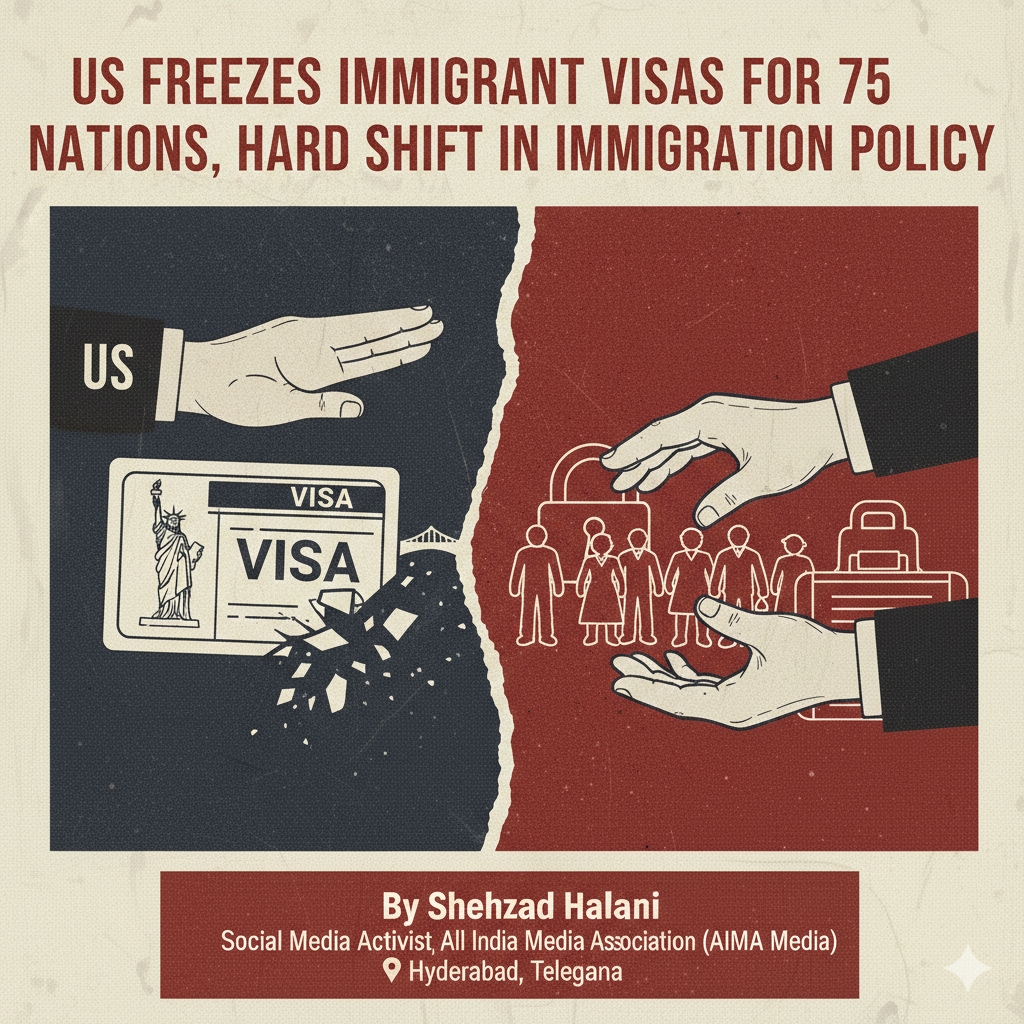
US Freezes Immigrant Visas for 75 Nations, Signals Hard Shift in Immigration Policy
In a major overhaul of America’s immigration framework, the United States has indefinitely frozen immigrant visa processing for citizens of 75 countries, marking one of the toughest policy shifts in recent years. The decision, announced by former US President Donald Trump on January 14, 2026, officially came into effect from January 21, 2026, with no clear timeline for reversal.
The move is being justified by the US administration as an effort to prevent “high-risk” immigrants from becoming dependent on American welfare and public benefit systems, signaling a clear departure from Washington’s traditionally open-door immigration narrative.
Pakistan and Bangladesh Among Major Targets
The suspension list includes several countries across Asia, Africa, and Eastern Europe — notably Pakistan, Bangladesh, Afghanistan, Iran, Nepal, Thailand, Uganda, Uzbekistan, Bhutan, and Russia, among others. India is not included, a fact that has drawn significant attention across diplomatic and diaspora circles.
According to the narrative presented by US policymakers, the decision is data-driven rather than ideological. Official data cited in public discourse suggests that around 40% of immigrants from Pakistan and nearly 55% from Bangladesh rely on US welfare schemes for survival — a statistic used to justify their inclusion in the freeze.
“Self-Sufficiency” at the Core of Trump’s Argument
President Trump has repeatedly stressed that immigration should benefit American citizens first. In his words, immigrants must be financially self-sufficient and should not exploit welfare schemes funded by US taxpayers. The administration argues that public resources are meant for American citizens, not as long-term support systems for new migrants.
This approach reflects Trump’s long-standing philosophy of economic nationalism — one that prioritizes fiscal responsibility and domestic welfare over humanitarian immigration narratives.
India’s Exclusion and the Diaspora Debate
Interestingly, Indians are highlighted as one of the highest-earning immigrant groups in the United States, with strong representation in technology, healthcare, business, and academia. Despite this, online discourse continues to show instances of racial hostility against Indians — a contradiction that raises questions about perception versus reality in global migration debates.
The exclusion of India from the ban reinforces the idea that economic contribution now outweighs emotional or historical ties in US immigration policy.
Pakistan: Strategy Over Sympathy
The decision also sheds light on Washington’s pragmatic view of Pakistan. Analysts argue that Trump’s policies are not driven by concern for Pakistani civilians but by geopolitical calculations, including military cooperation and strategic access to bases. This reinforces the belief that immigration decisions are deeply intertwined with global power politics.
America Is Changing
The video analysis suggests a hard truth — the United States is no longer the land where financial success is easily attainable for everyone. With rising costs, economic pressure, and political recalibration, America is redefining who gets access.
Trump’s announcement of a “Golden Visa” — aimed at wealthy investors — further underlines this shift, signaling that capital, not compassion, is becoming the primary gateway to America.
A New Era of Selective Immigration
The indefinite visa freeze represents more than a policy decision; it marks a philosophical transformation in America’s identity as a migrant nation. Immigration is no longer about opportunity alone — it is about economic value, self-reliance, and strategic alignment.
As global migration patterns evolve, countries like India may benefit from this new framework, while others face growing barriers. The world is entering an era where borders are no longer just guarded — they are strategically curated.