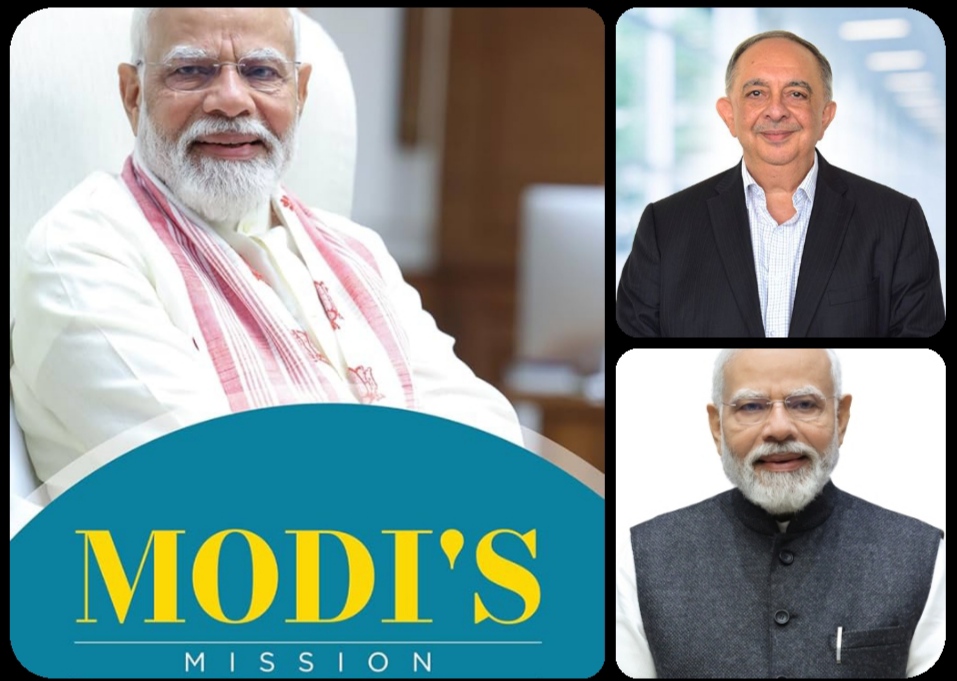
MODI'S MISSION: LEADERSHIP AS PURPOSE, POLITICS AS RESPONSIBILITY.
DHENKANAL; Dated 24/01/26
Modi’s Mission: Leadership as Purpose, Politics as Responsibility
Founder Editor’s Review
By Subash Chandra Dash
Founder Editor, Unmesh Time
In an era when political discourse is often dominated by immediacy, optics, and polarisation, Modi’s Mission by Mr. Berjis Desai stands out for its calm, reflective, and purpose-driven approach. The book does not attempt to be a routine political biography. Instead, it seeks to understand leadership as a calling shaped by conviction, discipline, and a larger national idea.
Mr. Desai approaches Narendra Modi not merely as a Prime Minister, but as a leader whose public life has been informed by an inner sense of mission. From modest beginnings to the highest office of the land, Modi’s journey is presented as one anchored in self-restraint, perseverance, and an unwavering belief in India’s civilizational strength. The book consistently places political events within a wider cultural and historical framework, encouraging the reader to see governance beyond daily headlines.
One of the book’s strengths lies in its clarity of intent. Mr. Desai does not indulge in exaggeration, nor does he reduce complex leadership decisions into simplistic narratives. His prose is measured, thoughtful, and accessible, allowing readers to engage with ideas rather than personalities alone. The emphasis is less on episodic politics and more on the philosophy that underpins long-term national direction.
It must also be noted that Modi’s Mission is largely affirmative in tone. Readers seeking a purely adversarial critique may not find exhaustive counter-arguments here. However, this is not a limitation so much as a conscious choice. The book declares its standpoint honestly and argues it with intellectual discipline—an approach that deserves respect in a time of ideological ambiguity.
A word on the author
Mr. Berjis Desai deserves appreciation for the seriousness with which he has treated his subject. His background as a lawyer and thinker is evident in the structure of the book, the restraint of language, and the absence of rhetorical excess. Rather than speaking about leadership from a distance, he attempts to understand leadership from within—through values, motivations, and historical continuity. Such writing contributes meaningfully to public discourse, regardless of political agreement or disagreement.
Concluding note
Modi’s Mission invites readers to reflect on an important question: Can public life still be guided by purpose rather than power alone? Whether one agrees with every conclusion or not, the book succeeds in restoring seriousness to the conversation around leadership and national vision.
For readers interested in contemporary India, leadership studies, and the idea of politics as responsibility, this book is a thoughtful and timely contribution.
— Founder Editor’s Recommendation, Unmesh Time