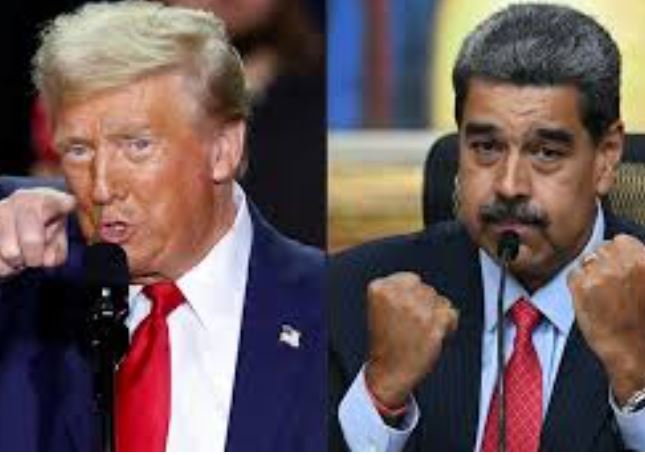
Why US Attacked Venezuela, Captured President Nicolas Maduro
President Donald Trump said United States forces had carried out a "large-scale strike" on Venezuela and captured its president, Nicolas Maduro.
New Delhi:
The residents of Caracas today were jolted awake by a short, violent sequence of explosions and the roar of low-flying aircraft. Within hours, an extraordinary claim followed from Florida: President Donald Trump said United States forces had carried out a "large-scale strike" on Venezuela and captured its president, Nicolas Maduro, flying him out of the country in a joint operation with US law enforcement agencies.
The announcement, made on Truth Social, capped months of mounting pressure on a government Washington has long rejected as illegitimate and framed a dramatic escalation of a campaign Trump says is aimed at drugs, migration and national security.
Why Did US Attack Venezuela
The stated reasons are migration, drugs, and "narco-terrorism".
Trump has repeatedly linked Venezuela to the arrival of hundreds of thousands of migrants at the US southern border. According to reports, since 2013, close to eight million Venezuelans are estimated to have fled economic collapse and political repression, most resettling elsewhere in Latin America. Without presenting evidence, Trump has accused Maduro of "emptying his prisons and insane asylums" and "forcing" inmates to migrate to the United States -- claims that Caracas categorically rejects.
The second stated reason is drugs. Trump has argued that Venezuela is a major transit route for cocaine and a contributor to the US fentanyl crisis. He has designated two Venezuelan criminal entities -- the Tren de Aragua and the Cartel de los Soles -- as Foreign Terrorist Organisations (FTOs). Trump has alleged that the latter is led by Maduro himself.
Caracas says Washington is weaponising the "war on drugs" to pursue regime change.
Strikes On Caracas
According to Trump, US forces executed a short, intense operation, capturing Maduro and his wife and flying them out of Venezuela. Trump said the action involved US law enforcement and promised details at a news conference at Mar-a-Lago. In a brief interview with The New York Times, he praised the planning and the troops involved.
On the ground in Caracas, witnesses reported explosions, power outages around military installations, and aircraft overhead. Video verified by the Associated Press showed tracer fire and smoke over the city and another coastal location. Venezuela's government accused the United States of attacking civilian and military sites and called on supporters to mobilise, declaring a state of "external disturbance".
Months Of Pressure
A large US naval and aerial presence was established in the Caribbean, including the aircraft carrier USS Gerald R Ford. US forces seized two oil tankers at sea as part of an oil blockade and acknowledged killing more than 100 people in strikes on small boats accused of drug trafficking. Trump said a docking area used by alleged drug boats had been destroyed -- the first publicly acknowledged strike on Venezuelan soil of the campaign.
The US government says it is engaged in an "armed conflict" with drug cartels.
Maduro has denied any role as a cartel leader and accused Washington of seeking to depose him to gain access to Venezuela's oil. He has pointed to offers of cooperation on drug trafficking and migration made days before the strikes.