Three Cities, Three Fires, One Troubling Question: Is Indias Urban Safety System Failing Beyond Paper Compliance?
A Special Investigative Analysis
Over the past few days, three major fire incidents in Delhi, Noida, and Indore have raised serious concerns about fire safety, urban planning, regulatory oversight, and administrative accountability in India.
At first glance, these incidents may appear unrelated. However, a deeper examination reveals a common pattern: safety lapses, inadequate preparedness, and systemic failures that could have turned each incident into an even greater tragedy.
---
Incident 1: Malviya Nagar, New Delhi
June 3, 2026 | Approximately 9:45 AM
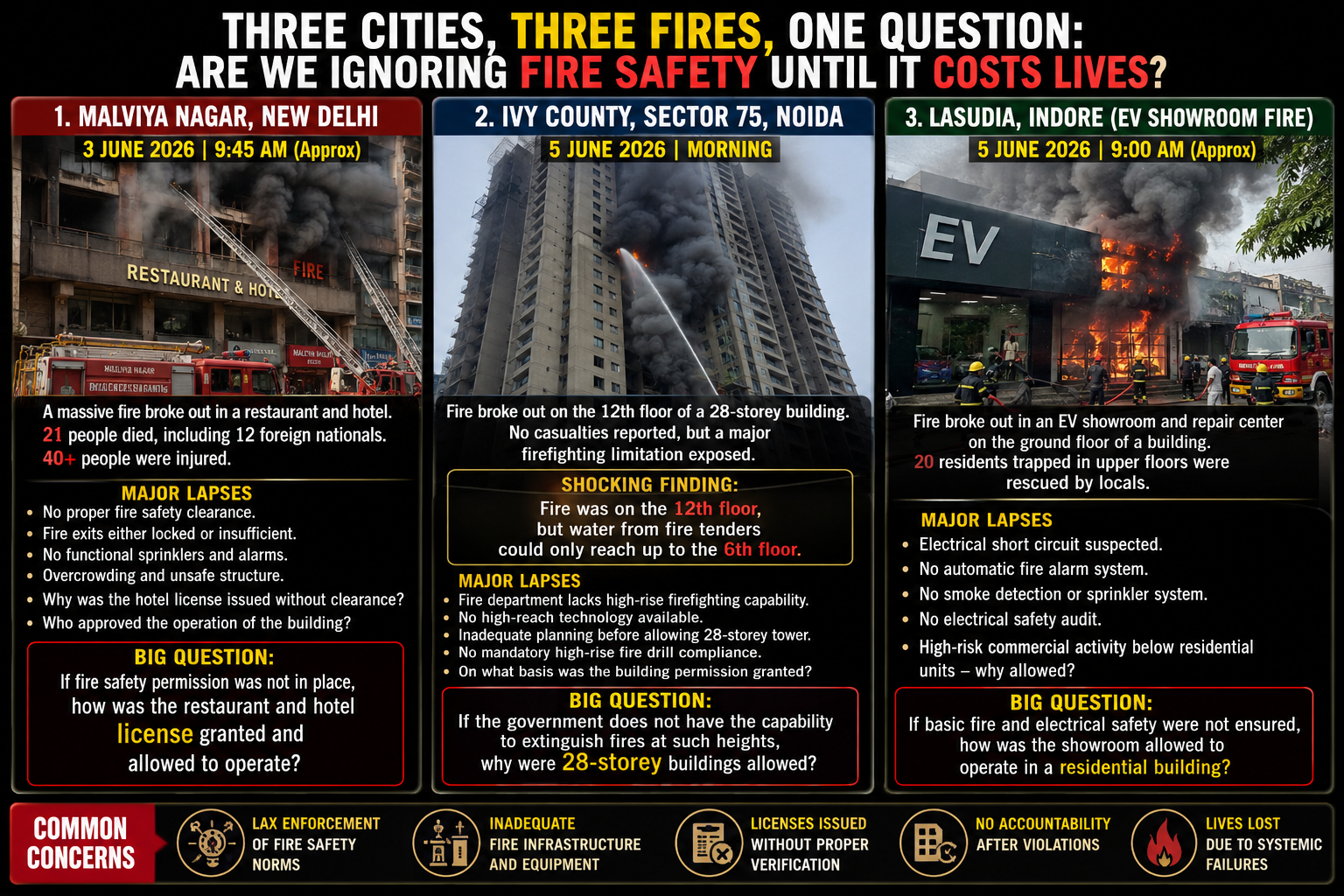
A devastating fire broke out in a building housing a restaurant and hotel in South Delhi's Malviya Nagar area.
The tragedy claimed 21 lives, including 12 foreign nationals, while more than 40 people were injured.
According to initial reports, the building allegedly lacked adequate fire safety clearance. The blaze spread rapidly, trapping guests inside. Several victims reportedly attempted to escape through windows and balconies.
This raises a fundamental question:
If proper fire safety clearance was not in place, how was the establishment allowed to operate?
If safety requirements were incomplete, then:
Who approved the commercial license?
Which authority conducted inspections?
Were fire safety audits properly performed?
Was regulatory compliance merely a formality?
The deaths of 21 people cannot simply be viewed as an unfortunate accident. They demand scrutiny of every administrative process that allowed such a high-risk environment to continue operating.
---
Incident 2: IVY County, Sector 75, Noida
June 5, 2026 | Morning Hours
A fire broke out on the 12th floor of the 28-storey IVY County residential tower in Noida.
Fortunately, no casualties were reported. However, the incident exposed a deeply concerning gap in emergency response capability.
According to reports and visual evidence from the scene:
The fire was on the 12th floor, but firefighting water streams appeared capable of reaching only around the 6th floor.
This immediately raises a larger question.
If emergency services cannot effectively reach and control a fire at such heights, on what basis are high-rise buildings being approved?
Before permitting a 28-storey structure, authorities should be able to answer:
Does the city possess adequate high-rise firefighting equipment?
Are aerial rescue systems available?
Can emergency responders safely reach upper floors during a major fire?
Has disaster preparedness kept pace with vertical urban development?
India's cities are growing upward at unprecedented speed.
But if emergency infrastructure is not growing at the same pace, then every additional floor becomes a new level of risk.
This incident ended without fatalities.
The next one may not.
---
Incident 3: EV Showroom Fire, Indore
June 5, 2026 | Around 9:00 AM
A fire broke out in an electric vehicle showroom and repair center located on the ground floor of a mixed-use building in Indore's Lasudia area.
Above the showroom, multiple families lived in residential units.
As flames and smoke spread through the building, the primary staircase became unusable.
Around 20 residents from six families became trapped and had to be rescued with the help of neighbors using ropes and ladders.
Thankfully, no lives were lost.
However, several critical concerns emerge.
Were adequate electrical fire safety systems installed?
Questions investigators and regulators must address include:
Was there an automatic fire alarm system?
Were smoke detectors operational?
Were sprinkler systems installed and maintained?
Were electrical systems regularly inspected?
Were EV-related fire risks properly assessed?
If a short circuit was indeed the cause, could the incident have been prevented through better safety measures?
Equally important:
How rigorously was the fire risk assessed before permitting a potentially high-risk commercial activity beneath residential housing?
---
Three Incidents. One Common Pattern.
Delhi witnessed a deadly tragedy that killed 21 people.
Noida exposed limitations in high-rise firefighting capability.
Indore highlighted the risks of inadequate safety measures in mixed-use buildings.
Different cities.
Different buildings.
Different circumstances.
Yet the same underlying concern remains:
The fire itself was not the first failure.
The first failure occurred much earlier—
when safety checks were ignored,
when regulations were inadequately enforced,
when preparedness failed to match development,
and when compliance became a checkbox rather than a responsibility.
---
The Bigger National Question
India is building:
Smart Cities
High-rise residential towers
Commercial mega-complexes
EV infrastructure
Urban transit networks
But is our safety infrastructure evolving at the same speed?
Can we confidently say:
Fire departments have the equipment they need?
Emergency response systems are adequately funded?
Safety audits are conducted independently and rigorously?
Violations lead to meaningful accountability?
Urban planning incorporates realistic disaster-response capabilities?
Or are we merely reacting after each tragedy instead of preventing the next one?
---
Questions That Demand Answers
If fire safety clearance was inadequate in Malviya Nagar, who allowed operations to continue?
If firefighting resources cannot effectively reach upper floors, why are increasingly taller buildings being approved?
If critical fire protection systems were missing in Indore, how was the facility permitted to operate?
These questions are not about assigning blame before investigations conclude.
They are about ensuring accountability, transparency, and public safety.
Because the next fire could happen anywhere.
And while no one can predict where the next emergency will occur, responsible governance can ensure that preventable tragedies are not repeated.
---
Conclusion
A nation is not judged by the height of its buildings, but by its ability to protect the people inside them.
Fire safety is not a procedural requirement.
It is a matter of life and death.
And the lessons from Delhi, Noida, and Indore must not be forgotten once the headlines fade.