Battle for Bengal: The 'SIR' Shockwave and a Dead-Heat Election
Conversation with Gemini
Prepare an image showcasing the fight between the two min vontenders of west bengal election. The attached images are just gor reference. Prepare a bombastic image with some vest taglines
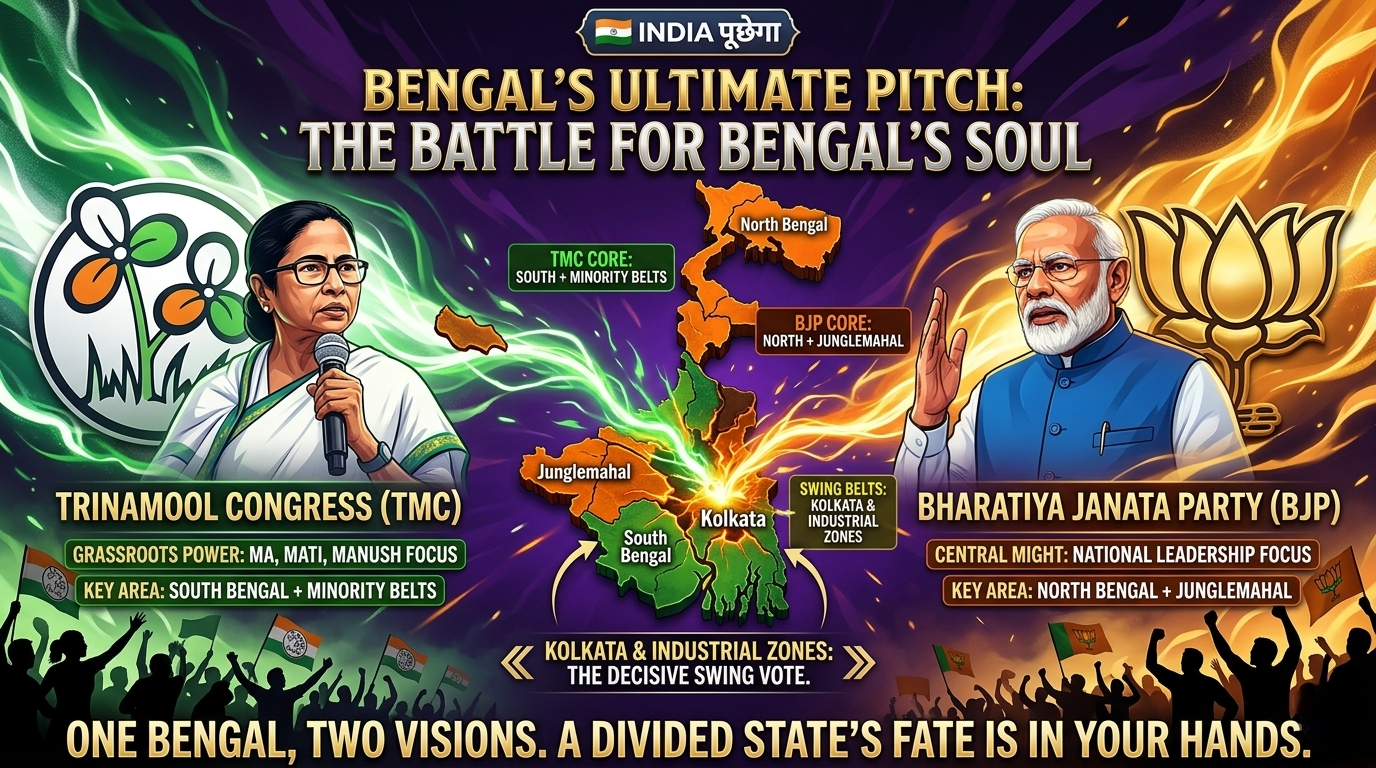
A bombastic, dramatic, high-energy graphic illustration, presented as a movie-poster-style infographic, visualizing the political clash for the West Bengal state elections. The overall style is modern and high-impact, with dynamic, swirling energy effects in deep purples, greens, and saffrons.
At the very top, in a stylized badge similar to ``, the text 'INDIA પૂછેગા' (verbatim from ``) is visible, with the Indian flag icon. Below it, the main bombastic headline reads: 'BENGAL'S ULTIMATE PITCH: THE BATTLE FOR BENGAL'S SOUL' in large, ornate, gold and silver letters.
The graphic is split into a tripartite structure. On the left side, under a swirling field of green and white energy, is a dynamic portrait of Mamata Banerjee from ``, white saree, resolute expression, hand holding a microphone (as in ``). Beside her is a large, detailed, stylized TMC grass-flower-and-leaves logo. Text below her: 'TRINAMOOL CONGRESS (TMC)' (bold). Specific points derived from ``: 'GRASSROOTS POWER: MA, MATI, MANUSH FOCUS', and 'KEY AREA: SOUTH BENGAL + MINORITY BELTS' (with small green labels). An energy arc is visible pulling a piece of the map.
On the right side, under a swirling field of saffron and gold energy, is a dynamic portrait of Narendra Modi from ``, blue waistcoat, resolute expression, hand raised (as in ``). Beside him is a large, detailed, stylized golden BJP lotus logo. Text below him: 'BHARATIYA JANATA PARTY (BJP)' (bold). Specific points derived from ``: 'CENTRAL MIGHT: NATIONAL LEADERSHIP FOCUS', and 'KEY AREA: NORTH BENGAL + JUNGLEMAHAL' (with small saffron labels). An energy arc is visible pulling a piece of the map.
In the center, between the two contenders, is a detailed map of West Bengal, clearly color-coded as in `` but with a fractured, molten, and collided appearance. Labels on the map are integrated: 'North Bengal' (saffron region), 'Junglemahal' (near saffron region), 'Kolkata' (green region), 'South Bengal' (green region). Energy streams of green (from TMC) and saffron (from BJP) are visible colliding and clashing dramatically directly over the central 'Kolkata & Industrial Zones' area (from ``), which is glowing and contested. Small text on or near the map: 'TMC CORE: SOUTH + MINORITY BELTS', 'BJP CORE: NORTH + JUNGLEMAHAL', 'SWING BELTS: KOLKATA & INDUSTRIAL ZONES'.
Below the central map conflict, a text panel with arrows pointing to Kolkata reads: 'KOLKATA & INDUSTRIAL ZONES: THE DECISIVE SWING VOTE.'
The bottom section features integrated silhouettes of cheering and contending crowds and party flags from ``, but more defined. A large final tagline stretches across the bottom: 'ONE BENGAL, TWO VISIONS. A DIVIDED STATE'S FATE IS IN YOUR HANDS.' The entire scene has a high-stakes, epic feel, with glowing edges and energy effects. The original text from `` about the regions is integrated as data points, but not all of it is verbatim on the map, rather placed for context. Specifically, 'TMC: South + Minority Belts' and 'BJP: North + Junglemahal' and 'SWING: Kolkata & Industrial Zones' are derived data and represented visually and in smaller supporting text panels., AI generated, AI generated
Write an exclusive analytical report on the current election at West Bengal with a survey based report. Current SIR implementation and what are the chances of winning of either party
Exclusive Analytical Report: West Bengal Legislative Assembly Election 2026
The 2026 West Bengal Legislative Assembly elections concluded on April 29, 2026, marking the end of a fiercely contested, high-stakes battle between the ruling Trinamool Congress (TMC) and the Bharatiya Janata Party (BJP). With the counting of votes scheduled for May 4, 2026, the political climate remains exceptionally tense. Below is a comprehensive analysis of the current landscape, the controversial electoral roll revisions, and the projected outcomes based on recent surveys.
Election Overview & Timeline
The election process was marked by high voter enthusiasm and an intense campaigning period.
The tenure of the outgoing West Bengal Legislative Assembly is scheduled to end on May 7, 2026.
The election was conducted in two phases, taking place on April 23 and April 29, 2026.
Voters cast their ballots to elect representatives for all 294 seats in the state assembly.
A party or coalition requires 148 seats to achieve a majority.
Voter turnout was exceptionally high, touching around 90% across various districts.
Purba Bardhaman recorded the highest participation with over 92% turnout.
The "SIR" Implementation and Its Impact
A defining and highly controversial element of the 2026 election cycle in West Bengal has been the Election Commission's Special Intensive Revision (SIR) of electoral rolls. Initiated to ensure accurate voter lists by removing deceased, non-citizen, or duplicate entries, the SIR's execution in West Bengal has heavily influenced the political narrative.
+1
Approximately nine million voters, representing about 12% of West Bengal's 76 million electorate, were removed from the rolls as part of the SIR.
More than six million of these deleted names were classified as either "absentee" or "deceased".
The ruling TMC has heavily criticized the process, alleging that genuine voters were deliberately disenfranchised.
Data reveals that 63% of the deleted voters in the state are Hindus, while 34% are Muslims, which is disproportionately higher than the state's 27% Muslim population.
Currently, 65% of the 2.7 million individuals whose voter status is still under adjudication belong to the Muslim community.
The highest number of voter deletions occurred in Muslim-majority border districts like Murshidabad and Malda, areas traditionally viewed as TMC strongholds.
The BJP maintains that the SIR process is a necessary step to eliminate illegal infiltrators from Bangladesh.
Following multiple lawsuits, the Supreme Court and the Calcutta High Court intervened, mandating that individuals cleared by tribunals before April 21, 2026, must be allowed to vote.
Survey-Based Report: Exit Poll Projections
With polling officially closed, exit polls project a sharply divided and neck-and-neck verdict. While multiple surveys indicate a significant surge for the BJP, a few project a decisive retention of power for the TMC.
The 2026 West Bengal Legislative Assembly elections concluded their two-phase polling on April 29, 2026, setting the stage for a high-stakes, strictly bipolar contest between the ruling Trinamool Congress (TMC) and the Bharatiya Janata Party (BJP). Historically dominant players like the Left parties and the Congress have been completely marginalized in this cycle. The state witnessed an extraordinary level of voter enthusiasm, with the second phase recording a massive turnout of 92.65%. A defining feature of this democratic exercise was the exceptional participation of women, who outpaced men by registering a 92.69% turnout compared to the male turnout of 90.92%. Amidst isolated incidents of violence, the Election Commission is currently evaluating demands from political stakeholders for repolling in 77 booths across South 24 Parganas due to alleged irregularities such as EVM malfunctions and intimidation. The ultimate verdict of this fiercely fought democratic exercise will be revealed when vote counting commences on May 4, 2026.
A deeply polarizing and central issue of this election cycle is the Election Commission's Special Intensive Revision (SIR) of electoral rolls, which was initiated in late 2025 to remove deceased, duplicated, and non-citizen voters. The implementation of the SIR resulted in the voter list shrinking from 7.66 crore to 7.04 crore electors, reflecting a massive deletion of over 61 lakh names. Furthermore, the electoral eligibility of an additional 2.7 million individuals remains trapped in judicial adjudication. The TMC has fiercely condemned the exercise as an intentional disenfranchisement of genuine voters, pointing out that 65% of those whose status is still under adjudication are Muslims and that the highest deletions occurred in minority-dominated border districts like Murshidabad and Malda, which are traditional TMC bastions. Conversely, the BJP defends the SIR as a vital mechanism to eliminate illegal infiltrators from neighboring Bangladesh. The resulting confusion on the ground has left numerous local families divided on polling day, with some relatives permitted to vote while others were suddenly turned away. In response to the escalating crisis, the Supreme Court directed appellate tribunals to grant out-of-turn hearings to excluded individuals who can demonstrate urgency, though it declined to mandate immediate inclusion for election duty officers who also found themselves off the lists.
With polling officially concluded, the release of multiple exit polls on April 29 has projected a fiercely tight race, with several agencies giving a slight edge to the BJP. Surveys conducted by Matrize project the BJP winning between 146 and 161 seats, while Chanakya Strategies estimates 150 to 160 seats for the party, both suggesting the BJP could cross the crucial majority mark of 148. To fuel this momentum, the BJP has heavily promoted welfare promises designed to undercut the TMC's base, offering ₹3,000 monthly to women and unemployed youth—effectively doubling the cash handouts of the TMC's existing Lakshmir Bhandar and Banglar Yuva Sathi schemes—alongside pledges to implement a Uniform Civil Code. However, the contest is far from decided, as other polling agencies like Peoples Pulse and Janmat Polls forecast a clear and decisive advantage for the TMC alliance, projecting them to secure anywhere between 177 and 205 seats. Chief Minister Mamata Banerjee has publicly dismissed the pro-BJP exit polls as fabricated narratives aired under the BJP's instruction to demoralize her cadre, resolutely asserting that the TMC will ultimately capture more than 226 seats. Given the intensely narrow margins across various projections and the unprecedented impact of the SIR deletions on traditional voting blocs, the true outcome of this historic battle for West Bengal remains precariously balanced until the final count.