Mussoorie & Landour: Renaming Debate Raises Questions of History, Identity and Governance in the Hills
A debate in Mussoorie reveals a deeper question—are we correcting history or overlooking it?
What began as a late-night reaction to a post on X soon turned into something far more meaningful—a layered conversation among residents, researchers, and long-time observers of Mussoorie’s past.
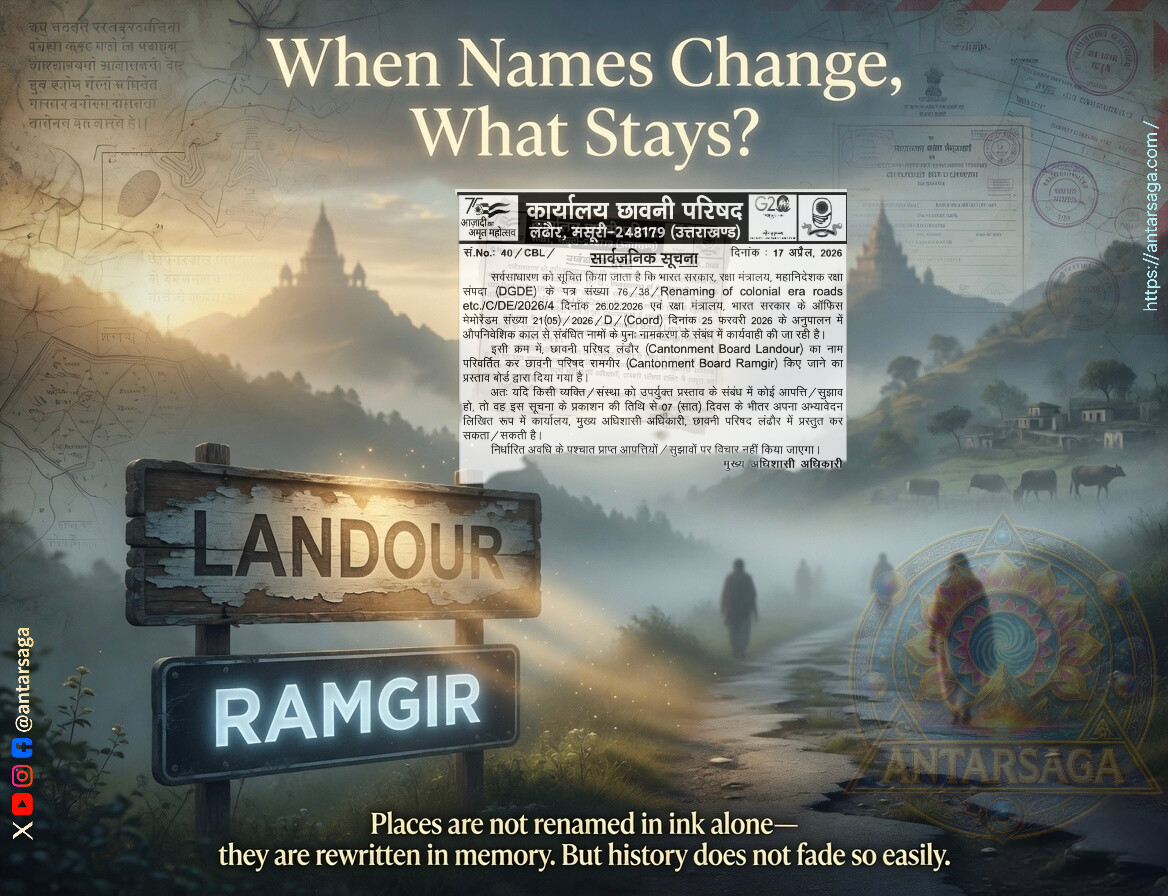
At the heart of the debate was a proposal to rename parts of Landour—reportedly to “Ramgir”—a move that left many puzzled, and some concerned.
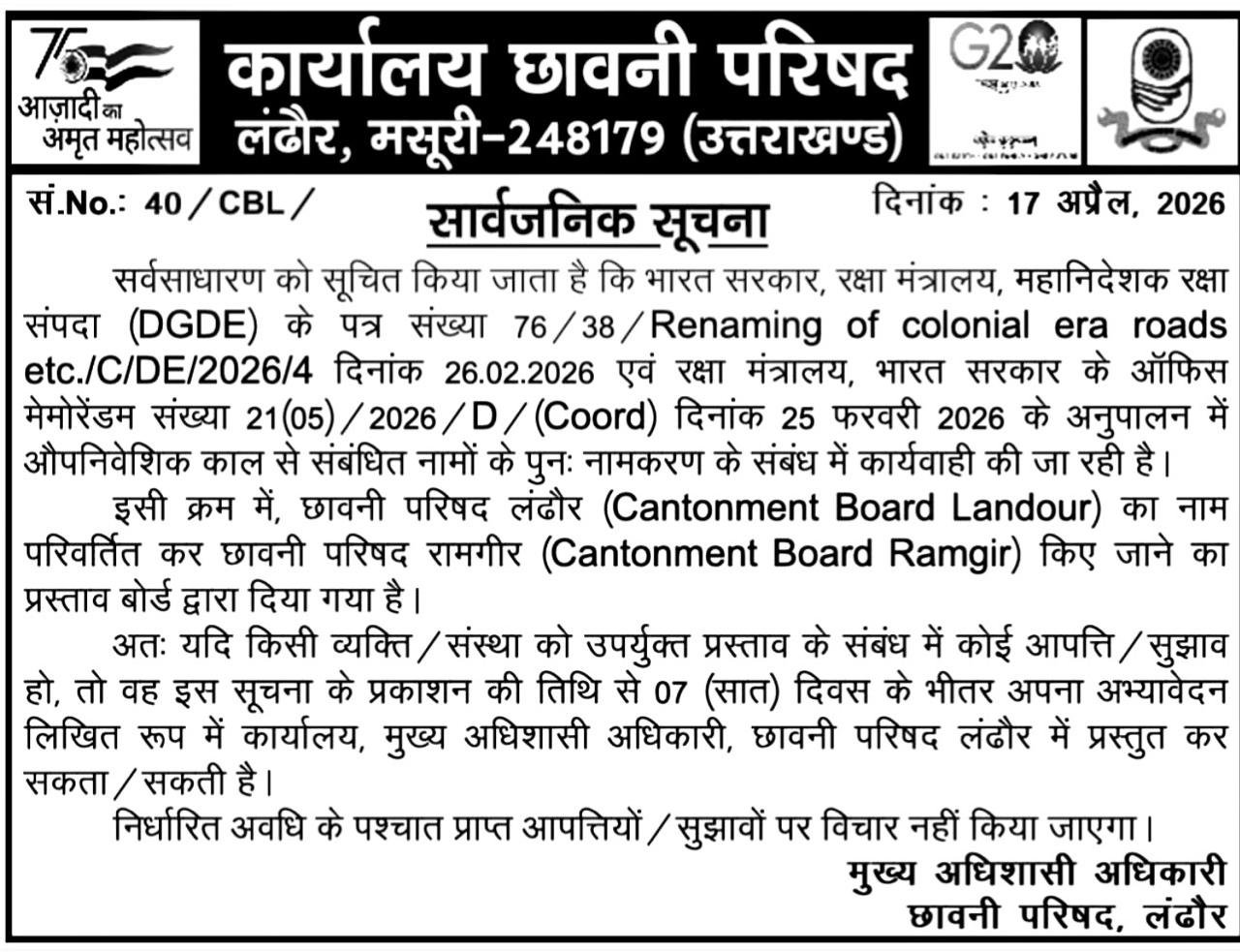
A public notice issued by the Cantonment Board Landour on April 17, 2026—referencing a Ministry of Defence directive on renaming colonial-era roads—has since confirmed that the proposal is official. The Board has invited objections and suggestions within seven days of the notice.
“I don’t understand why the names are being changed,” noted author and researcher Anmol Jain, who has extensively studied the region. “Landour is not even a British name. It was derived from a village that existed before the cantonment came up.”
That single observation shifted the tone of the discussion. What was initially seen as another attempt to shed colonial remnants began to look more complicated.
Because Mussoorie, as several participants pointed out, is not merely a colonial construct.
Long before the British arrived, these hills carried names, meanings, and lives of their own.
From the Katyuri rulers to the Panwar dynasty, from ancient temple routes connecting Surkanda Devi and Bhadraj, to villages like Kyarkuli, Bhatta, and Kolri—the region was already a lived geography. Dense forests, footpaths, grazing lands, and sacred routes defined its identity.
Even the Mall Road, today a symbol of colonial-era leisure, was once a narrow pathway linking pilgrimage sites.
“Mussoorie’s identity is layered,” one participant observed. “It evolved—it wasn’t imposed.”
And that is where the discomfort with renaming begins.
Because if a name like “Landour” has roots that predate colonial administration, then changing it in the name of decolonisation risks doing the very thing it seeks to correct—disconnecting a place from its authentic past.
More troubling, however, is the apparent arbitrariness of replacement.
“What is the connection of ‘Ramgir’ to Mussoorie?” one voice asked. No clear answer followed.
This raises a larger question:
Are we restoring history—or selectively rewriting it?
The issue is not whether names should or should not change. History is not static, and societies often revisit their past. But such decisions demand depth, research, and cultural continuity.
Without that, renaming becomes less about reclamation and more about replacement.
And beyond history lies another, more immediate concern—governance.
As the discussion unfolded, a quieter but sharper point emerged.
While names are being debated and potentially changed, the everyday realities of Mussoorie remain unchanged. Roads continue to strain under pressure, waste management remains a challenge, water systems are inconsistent, and ecological stress is increasingly visible.
For residents, these are not symbolic issues—they are lived ones.
Which is why, for many, the timing feels misplaced.
Renaming may reshape memory.
But governance is measured in experience.
A city does not function better because its signboards change.
It functions better when its systems do.
Perhaps, then, the way forward is not to reject change entirely—but to approach it with care.
To recognise that places like Mussoorie are not blank slates waiting to be renamed, but layered landscapes where history has accumulated over centuries.
And to remember a simple principle:
Names should grow from history, not be assigned without roots.
With the Cantonment Board inviting objections within a limited window, this is not just a conversation—it is a moment for civic participation.
Because in the end, the future of a place should not be decided in isolation from the people who live its present—and carry its past.
Objections are open only till April 24—if the hills matter to you, this is the moment to speak.