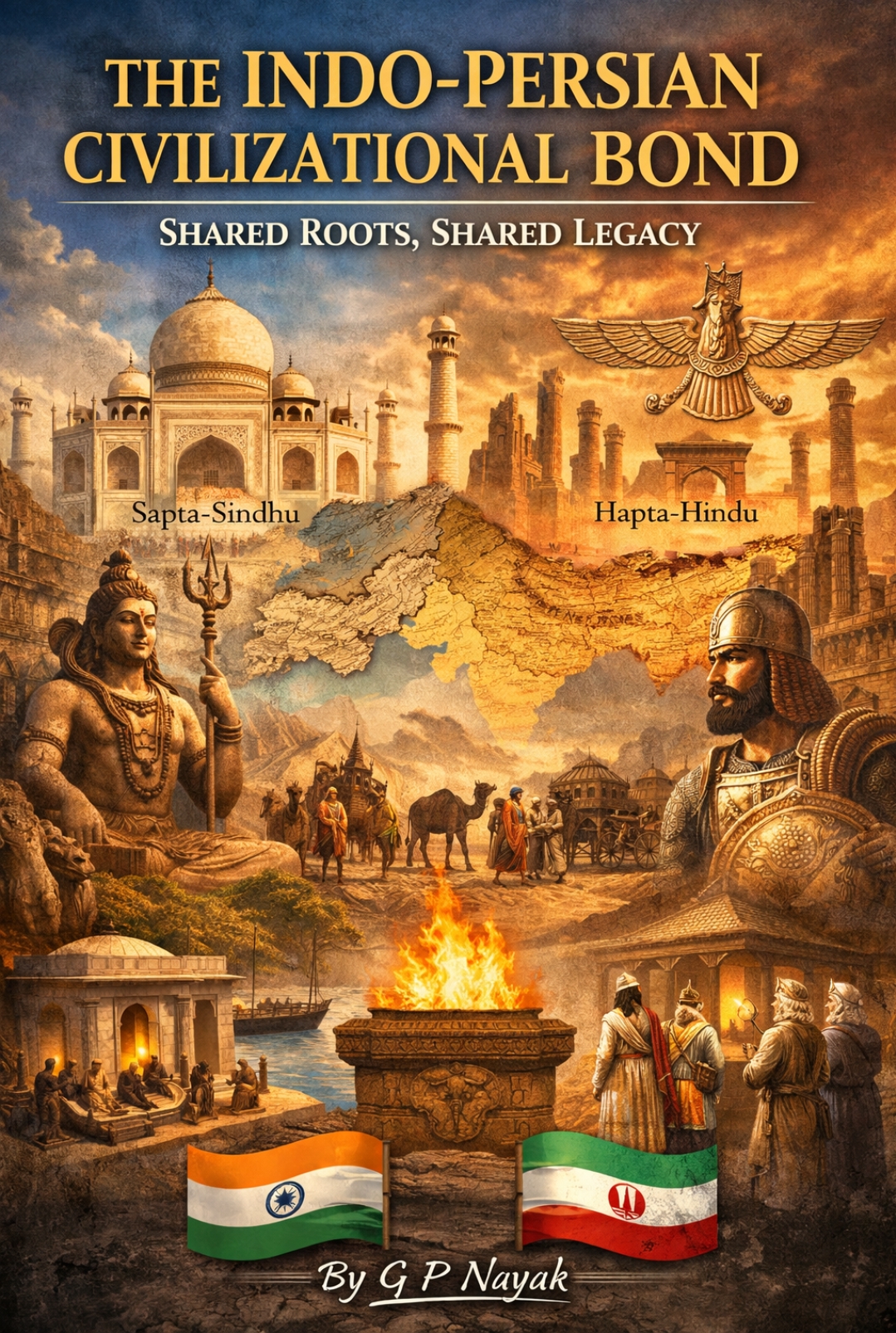
The Indo–Persian Civilizational Bond: A 3,000-Year Legacy of Shared Roots
The civilizational relationship between India and Iran stretches back thousands of years, long before the emergence of modern nation-states. Scholars trace this connection to the ancient Indo-Iranian branch of the Indo-European peoples, from which both early Vedic society in the Indian subcontinent and the early Iranian civilizations evolved. This shared origin is reflected most clearly in language, where striking similarities exist between Sanskrit and Avestan, the liturgical language of ancient Iran. Words such as “sapta” in Sanskrit and “hapta” in Avestan, both meaning seven, or “sindhu” transforming into “hindu” in Old Persian, point to a deep linguistic and cultural kinship preserved over millennia.
Ancient texts further reinforce this connection. The Rigveda refers to the region of northwestern India as “Sapta-Sindhu,” or the land of seven rivers, while the Avesta mentions a similar region as “Hapta-Hindu.” These parallels suggest not only shared geography in early memory but also overlapping cultural frameworks before the two traditions gradually diverged. Religious concepts, too, show common roots. Deities such as Mitra and Mithra, as well as Yama and Yima, reflect a shared mythological heritage, even as theological interpretations evolved differently over time.
The divergence became more pronounced with the teachings of Zoroaster, who reformed earlier belief systems and established the foundations of Zoroastrianism. In this process, certain concepts took on contrasting meanings across the two cultures. For instance, “deva,” a term for gods in Vedic tradition, came to denote malevolent forces as “daeva” in the Iranian context, while “asura,” which carried complex connotations in India, is linguistically linked to “ahura,” as in Ahura Mazda, the supreme deity of Zoroastrianism. This illustrates not a simple borrowing of ideas but a shared origin followed by independent religious evolution.
Historical interactions between the two regions were not limited to culture and language. During the reign of Darius I, parts of the northwestern Indian subcontinent, including Gandhara and Sindh, became provinces of the Achaemenid Empire. This political integration facilitated trade, administrative exchange, and military cooperation. Indian soldiers served in Persian armies, and economic networks connected the Indus Valley with the broader Persian world. Centers of learning such as Taxila emerged as hubs of intellectual exchange, attracting scholars and administrators from multiple regions, including Persia.
Over the centuries, trade and migration continued to strengthen ties between the two civilizations. While some popular narratives suggest the presence of ancient Indian deities deep within Iran, historians emphasize that most material evidence of Indian cultural presence in Iran dates to later periods, particularly through merchant communities and sustained commercial contact. For example, the well-known temple at Bandar Abbas was established in the 19th century by Indian traders, reflecting enduring economic and cultural links rather than ancient settlement patterns.
A major turning point in Iranian history came with the fall of the Sasanian Empire in 651 CE, following the Arab conquests. This period marked the gradual decline of Zoroastrian political dominance in Iran. Facing changing conditions, a group of Zoroastrians migrated across the Arabian Sea to the western coast of India, particularly Gujarat, between the 8th and 10th centuries. There, they were granted refuge and eventually became known as the Parsis, a community that would go on to play a significant role in India’s social and economic development.
One of the most enduring symbols of this migration is the sacred fire maintained at Udvada, home to the Iranshah Atash Behram, one of the most revered fire temples in Zoroastrianism. This flame, said to have been burning for over a millennium, represents both continuity and adaptation, preserved not in its land of origin but in a new cultural setting that allowed it to survive. It stands as a testament to India’s historical role as a place of refuge and cultural preservation.
Despite occasional indirect conflicts through larger imperial dynamics, the broader history of India and Iran is characterized more by exchange than by sustained warfare. Trade routes, diplomatic contacts, and shared intellectual traditions contributed to a relationship that endured across centuries. Today, this long-standing connection continues to influence cultural, linguistic, and geopolitical interactions, reminding both nations of a shared past that predates modern political boundaries.